Yesterday was a very full day - the highlight was visiting the artist, Francisco Brennand on his 4000 acre estate near Recife. Francisco is the descendant of 19th century Irish immigrants to Brazil. His father ran a brick and tile works and Francisco inherited it. For the last 40 years, he has been working in clay and is about 85 years old. Before that, he painted and still paints in as he says "a more traditional and less controversial style." His clay sculptures, some of which are absolutely monumental, decorate the grounds of his estate as well as the interior of the converted tile factory and gigantic kilns. The buildings are absolutely beautiful. his cousin, Ricardo Brennand also has a sizeable estate but has chosen to house his 5000+ collection of swords in a medieval styled castle. He also has, in his collection, armor and paintings. We weren't able to see Ricardo's collection but had the opportunity to actually talk with the artist since one of the former ambassadors of Brazil accompanied us and is a personal friend.
I asked Francisco where the clay came from and what kind of glazes he used. He said that the clay was specially chosen from a place in Pernambuco because of its properties and the glazes were not scientifically applied or mixed but were rather the result of such a long experience with them. I took lots and lots of pictures of the sculptures, tile wall collages and the temple. Outdoors, he has a sacred site with a blue egg shaped dome that colors everything with a celestial blue hue when the sun is directly overhead.
I have to disagree with Lonely Planet's description of this famous artist and site. They describe his work as weirdly sexualized earthworms, lizards and frogs. Did they actually see his work? Yes, some of the pieces might appear phallic at first glance and yes, sensuality and sexuality is a part of Francisco's style but he makes frequent references to creation, mythology, history and biblical references with a twist. Adam and Eve are represented outside as is Cain but Cain is given complete redemption in Francisco's interpretation as he should be. He is the one who gave the gifts of the earth and the harvest rather than shedding the blood of animal in sacrifice to God. Frogs and fish emerge from the waters of the pools and fountains, large ceramic eggs stand on end ready to hatch into what the viewer chooses to imagine. Inside, Joan of Arc has two heads symbolizing perhaps her two natures or the way that she was both virgin and dressed as a man to get the job done of crowning the Dauphine King of France.
One can feel a mysticism and animism and spiritual force walking around Brennand's clay bodies and forms. He said that none of them can be moved or separated from each other. Another quotation that I found very inspiring was "My art may be immovable but it is not inert." In fact, nothing on earth is inert, not even rocks, rivers or sand. Everything is alive. Before leaving all too soon, I was able to buy a small sphere from the restaurant gift area made by Brennand that I will keep in my office in our new Art building so that I can be reminded of the Brazilian artist with the kindly face who is one of Brazil's most important living artists. If you go to Brazil you must visit both cousins. They are exceedingly kindly men, our tour guide, Ni tells us - she is a native Pernambuca native Brazilian - who do a lot for the poor in the municipality.
The talk about urban planning in the state was not as inspiring, I'm afraid. It focused on development of the Boa Viagem beachfront area and moving the poor out of their shanty towns along the waterfront where they eke out a living by fishing. The solution, unfortunately for low income housing is to move people out to the fringes of the city where it is nearly impossible to get to any kind of work situation. In some areas that we passed through in Recife like San Antonio and San Jose, there has been frequent flooding so that some houses that used to be for the wealthy were abandoned. Gabe and I have decided that we could start a business here with a power washing company to get rid of the mold that seems to constantly endanger the health of Recife's inhabitants. We would add a little bleach to it and then sell at low cost, dehumidifiers too. Gabe is my fellow Hawaiian from Hilo - he has taught at the community college there for over nine years so he's become an official Hawaiian native in my classification.
That was Monday July 11. Now today, July 12, we had an appointment to visit the new Port of SUAPE nearly one and a half hours away. It takes such a long time because first of all, the roads are terrible with potholes like you can't believe. And then there is the traffic. Anyway, we were presented with a 9 minute slick video about the publicly owned port of Suape (which we were given as well along with the power point on CD) which is giving private companies huge tax incentives to ship things in and out of Brazil. The tax break is around 75% so it will definitely benefit those private companies. There is a shipyard, fiberglass company, resin company and lots of others. They say they are dedicated to sustainability and maintaining a large green area around the port. They have two Goliath cranes that can lift 1500 tons which is important in shipbuilding. Suape has very deep water at its port and is the closest to Africa of any site in Brazil. Their plans are expansive and will give jobs to many Brazilians in this state. Well, more jobs as they are building the port and other buildings and less when the building is complete. Of the total number the private companies are supposed to employ 50% Brazilians - I imagine for the lower paying jobs.
I asked about waste management and air quality control for pollutants. I was told that containment areas were designated and when I asked where? I didn't feel that I was answered in detail but we were given the email account of the VP who spoke with us and he promises to find answers and then get back to us. Hopefully there will be no DuPont situations or oil spills. They have very close offshore oil sites and oil refineries are being built by Petrobras, the largest oil company in Brazil on the site as well. I took some photos from a site where our bus drove us so that we could see an over view. Pernambuco is one of Brazil's poorer states.
Is Brazil a country of the future? Will Brazil be able to reap the benefits the capitalism without selling its soul and the health of its people? Many other questions will come up I'm sure as I think about the ramifications of conservation, sustainability, social welfare, etc.
Wednesday, July 13, 2011


Friday, December 18, 2009
Islamic New Year
Delivered the two paintings to Soheir Osman at the Faculty of Applied Arts at Helwan University. Their International Festival is Monday, Dec. 21st, the Winter Solstice. She liked these paintings a lot. Met another artist,Dr. Mostafa Kamal. Will visit his new art school in 6 October city soon.
Yesterday, the 17th of December was noteworthy for being the Roman Saturnalia and the sunset start of the Islamic New Year. As far as the New Year here in Cairo, I was told by Ali (the IT guy at Fulbright) - he had come to work on my wireless - he said people eat meat. What? OK at iftar (the breaking of the fast at each Ramadan day or else the Eid - people eat meat especially the common people. Rich people eat meat a lot and Copts each pork. My sister Liz, does turkey AND ham on Christmas day and a rib roast on Christmas Eve if she can afford. I'll say, rib roast and beef tenderloin cost a lot. I'll be missing Peggy's awesome beef tenderloin with reduced port sauce and the scalloped potatoes with mushrooms.
"The Islamic New Year is a cultural event which Muslims observe on the first day of Muharram, the first month in the Islamic calendar. Many Muslims use the day to remember the significance of this month, and the Hijra, or migration, Islamic prophet Muhammad made it to the city now known as Medina. Recently, in many areas of Muslim population, people have begun exchanging cards and gifts on this day, though this is not commonly done. For Shia Muslims, Muharram is the month grief and sorrow because they mourn the death of Imam Hussain and his companions on the day of Ashura.
Ras as-Sana (Arabic: رأس السنة ) is the Islamic celebration of the new Hijri year. The term is similarly used in the Arabic language to mark the start of the new Gregorian year. The word literally means "Head of the year," and is cognate to the Hebrew term Rosh Hashanah. Since the Islamic lunar calendar year is 11 to 12 days shorter than the solar year, Muharram migrates throughout the seasons."
I made brownies today from a Betty Crocker mix -it was easier than homemade though we do have the ingredients to make Christmas cookies with brown suger, flour, eggs, spices, chocolate chips both milk and semi sweet and walnuts. I even found a molasses brown sugar so Dominique can try to make gingebreak cookies.
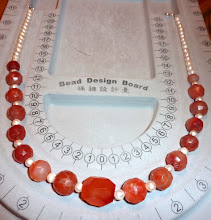
Today, I stayed at home and made some necklaces - well, as far as I could get without the necessary technique to finish them off. I spent all afternoon at the Khan el Khalili armed with my business cards for the Bedouin Shop to see Ahmed. I bought the most magnificent vintage Mosque lamp with colored glassw inserted so when the light shines through, it is gorgeous. I bought some beads and some more Bedouin stuff from Nasser brothers - he has a picture of himself with the Queen of Spain on the back wall. Tiny store. Had tea at the Pancake House and waited for traffice to die down around 7 pm.
Yesterday, the 17th of December was noteworthy for being the Roman Saturnalia and the sunset start of the Islamic New Year. As far as the New Year here in Cairo, I was told by Ali (the IT guy at Fulbright) - he had come to work on my wireless - he said people eat meat. What? OK at iftar (the breaking of the fast at each Ramadan day or else the Eid - people eat meat especially the common people. Rich people eat meat a lot and Copts each pork. My sister Liz, does turkey AND ham on Christmas day and a rib roast on Christmas Eve if she can afford. I'll say, rib roast and beef tenderloin cost a lot. I'll be missing Peggy's awesome beef tenderloin with reduced port sauce and the scalloped potatoes with mushrooms.
"The Islamic New Year is a cultural event which Muslims observe on the first day of Muharram, the first month in the Islamic calendar. Many Muslims use the day to remember the significance of this month, and the Hijra, or migration, Islamic prophet Muhammad made it to the city now known as Medina. Recently, in many areas of Muslim population, people have begun exchanging cards and gifts on this day, though this is not commonly done. For Shia Muslims, Muharram is the month grief and sorrow because they mourn the death of Imam Hussain and his companions on the day of Ashura.
Ras as-Sana (Arabic: رأس السنة ) is the Islamic celebration of the new Hijri year. The term is similarly used in the Arabic language to mark the start of the new Gregorian year. The word literally means "Head of the year," and is cognate to the Hebrew term Rosh Hashanah. Since the Islamic lunar calendar year is 11 to 12 days shorter than the solar year, Muharram migrates throughout the seasons."
I made brownies today from a Betty Crocker mix -it was easier than homemade though we do have the ingredients to make Christmas cookies with brown suger, flour, eggs, spices, chocolate chips both milk and semi sweet and walnuts. I even found a molasses brown sugar so Dominique can try to make gingebreak cookies.
Today, I stayed at home and made some necklaces - well, as far as I could get without the necessary technique to finish them off. I spent all afternoon at the Khan el Khalili armed with my business cards for the Bedouin Shop to see Ahmed. I bought the most magnificent vintage Mosque lamp with colored glassw inserted so when the light shines through, it is gorgeous. I bought some beads and some more Bedouin stuff from Nasser brothers - he has a picture of himself with the Queen of Spain on the back wall. Tiny store. Had tea at the Pancake House and waited for traffice to die down around 7 pm.
Tuesday, December 15, 2009
New Abstract paintings completed
Picked up my two paintings, framed and adhered to the foam core board today from Mr. Helmy, aka, the Framer, on Yehia Ibrahim Street in Zamalek. I had to put the four freshly painted portraits on the one and add some calligraphy and color to it as well. Just tweaked the first one and got rid of the black line beneath the Bedouin portraits at the bottom of the painting. I'm posting the photos of the paintings as well as the el Nafeza paper paintings of the Bedouin woman and children. I figured since the paintings are based on a rusty door that I saw in Al Arish in north Sinai, that Bedouin women and children were appropriate portraits to add. Also, I did a little Arabic calligraphy. Thought I was spelling Bedouin door and Mother and children but also blurred those lines with paint. The door was rusty with layers of black, white, blue and yellow paint. I'm pretty happy with it and hope that my audience likes it as well. It's for an International Group Show at the Opera House probably Al Bab Gallery next to the Modern Art Museum again.
Monday, December 14, 2009
Cocktails on Jamie's Houseboat
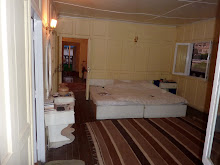
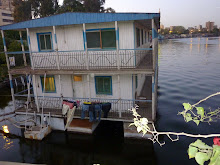
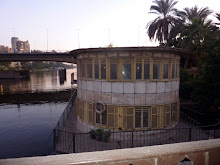
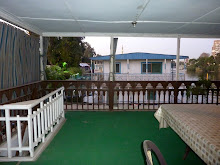
Sunday, yesterday, Karl, Joelle and I were invited to Jamie's houseboat in Kit Kat, Imbaba, Cairo. Just past the Zamalek bridge, is Jamie's rental - it is very rare for anyone to get one of these as they belong to families who might come to visit a few months out of the year like the Sudanese family who own his and live in the U.S. Jamie's apartment is the upper floor of a two apartment houseboat. His is enviable - he has a very large covered patio space with a two bedroom, two bath, living room, dining area, kitchen and a wrap around porch. Everything, one desires in houseboat living. True, it does get cold in the winter and there is no air conditioning but he does have a TV - it came furnished too and has internet access. His beds look as if they can sleep three people each, he says five but the Brits get cozier than Americans. Our king sized beds are only for two.
I took lots of pictures and will be there again, as he invited us for a New Year's Eve party with about 30 people. I was hoping for a good invitation - I'll bring Carla as she will be with me from that time. Jamie has worked for Oxfam for the last 17 years and is just about ready to turn over his directorship - he officially stopped working for them but wants to pass on the baton so that his replacement is properly trained.
After plied with many glasses of beer, we staggered off to get to our party in Zamalek at the Lohof's. I was worried about my inebriation but apparently, others were feeling as happy as I was. We had to say au revoir to Karl last night as he was leaving early this morning to get back to Alexandria by train. He was such a good house guest - loved our conversations. I would love to find someone as nice but he is taken. We both have to leave Cairo on the 17th of January so he will probably spend his last day or two back at our place.
Will add more soon
I took lots of pictures and will be there again, as he invited us for a New Year's Eve party with about 30 people. I was hoping for a good invitation - I'll bring Carla as she will be with me from that time. Jamie has worked for Oxfam for the last 17 years and is just about ready to turn over his directorship - he officially stopped working for them but wants to pass on the baton so that his replacement is properly trained.
After plied with many glasses of beer, we staggered off to get to our party in Zamalek at the Lohof's. I was worried about my inebriation but apparently, others were feeling as happy as I was. We had to say au revoir to Karl last night as he was leaving early this morning to get back to Alexandria by train. He was such a good house guest - loved our conversations. I would love to find someone as nice but he is taken. We both have to leave Cairo on the 17th of January so he will probably spend his last day or two back at our place.
Will add more soon
Thursday, December 10, 2009
Bedouin trinkets at Atef Wassef
Without too much trouble, I managed to get to the silversmith's store - Atef Wassef. Mona, the owner and pharmacist of Nefertari Cosmetics had told me about this store. Her jewelry is so gorgeous that I am going to try to copy the coral and silver necklace she was wearing when I met her. Atef Wassef is located downtown at 54, Kaleq Sarwat Street perpendicular to the Corniche and near the Nasser Metro stop. The store is colorfully painted on its exterior, pink, blue and white in arabesques. The store is huge, two life sized bronze horses in the front part of the store.
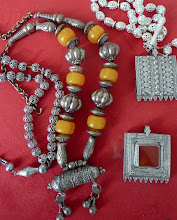
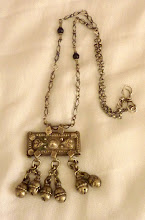
Mona, a new Egyptian friend I met in the White Desert and owner/entrepeneur of Neferari Cosmetics told me about Atef Wassef, whose store is downtown. He had two big baskets full of all kinds of Bedouin belts, necklaces, bits and pieces. As I and two assistants pawed through the piles, my hands turned black with tarnish. Bedouin pieces are usually 60% silver (which makes them cheaper per gram to buy around 3.5 LE). Right now I am wearing a wonderful ring with an intaglio horse carved carnelian stone with tiny turquoise stones on the sides. It could be from Turkestan (Afghanistan). For a heavy sack of things, it came to 1765 LE around $300. I have enough to make about 10-12 necklaces as I concentrated on buying pendants though I did purchase some earrings too. They are generally called zar pendants - meant to protect the wearer and attached not to the earlobe, but to a Bedouin woman, attached to her head scarf near her ears.
Mona, a new Egyptian friend I met in the White Desert and owner/entrepeneur of Neferari Cosmetics told me about Atef Wassef, whose store is downtown. He had two big baskets full of all kinds of Bedouin belts, necklaces, bits and pieces. As I and two assistants pawed through the piles, my hands turned black with tarnish. Bedouin pieces are usually 60% silver (which makes them cheaper per gram to buy around 3.5 LE). Right now I am wearing a wonderful ring with an intaglio horse carved carnelian stone with tiny turquoise stones on the sides. It could be from Turkestan (Afghanistan). For a heavy sack of things, it came to 1765 LE around $300. I have enough to make about 10-12 necklaces as I concentrated on buying pendants though I did purchase some earrings too. They are generally called zar pendants - meant to protect the wearer and attached not to the earlobe, but to a Bedouin woman, attached to her head scarf near her ears.
Wednesday, December 9, 2009
Another NGO in Mokkatam
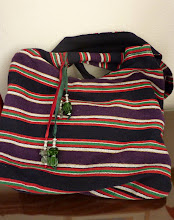
Today I went downtown after the W.A.'s Christmas party. They had someone making Irish coffee with real Irish whiskey. The woman who fixed it for me (20 LE) was generous with the whiskey and there was plenty of fresh whipped cream. I bought a loaf of banana bread for 20 LE (omg, fabulously moist, redolent of bananas, no nuts but didn't miss them) and a date cake for 50 LE. Everything to benefit the W.A.'s coffers - they have charitable projects. Met a women there selling these bags made by a group of women at the Garbage Collectors Village but at St. Simon the Tanner's church there.She is Dutch (Fenneke) and has been working with the women here since May 2008. The Center there had a small training center for making clothes but they had no work and they asked her if she had work for them. After a few days, she found the cloth made in Egypt called Khayameya - it's made 100% in Egypt, 100% Egyptian cotton, colorful and very sturdy. She thought they would make good aprons and then brought the six yards of material she had purchased to the Center along with her apron as a pattern.
In August of 2008, she had the women making bags - one of which I bought for 60 LE. In one year, the women had made 2500 aprons and 4200 bags. With that, they can earn a fair trade salary, the Center was able to purchase several sewing machines and an industrial ironing board. Any profits benefit the Amalna Home which is an orphanage for 8 girls. A nursery for Sudanese refugee children in Nasr City with monthly salaries for 5 people, rent and electricity paid for as well as contributing toward Operation Smile Egypt which offers free surgeries for children born with cleft palate. I found some information by googling Amalna Home and Fenneke has given my information to Laila, a woman who now runs the organization at St. Simon's. Fenneke was going back to Nairobi and wanted to start some other NGOs but with the help of a few others as it is so much work to do it alone, she told me.
In August of 2008, she had the women making bags - one of which I bought for 60 LE. In one year, the women had made 2500 aprons and 4200 bags. With that, they can earn a fair trade salary, the Center was able to purchase several sewing machines and an industrial ironing board. Any profits benefit the Amalna Home which is an orphanage for 8 girls. A nursery for Sudanese refugee children in Nasr City with monthly salaries for 5 people, rent and electricity paid for as well as contributing toward Operation Smile Egypt which offers free surgeries for children born with cleft palate. I found some information by googling Amalna Home and Fenneke has given my information to Laila, a woman who now runs the organization at St. Simon's. Fenneke was going back to Nairobi and wanted to start some other NGOs but with the help of a few others as it is so much work to do it alone, she told me.
Tuesday, December 8, 2009
Nomad Store and a new phone
I thought today was the Christmas coffee party at the Women's Association in Zamalek and I got there around 11:20 but there was no one there. The party is tomorrow which is Wednesday. I just thought it was Wednesday because Dominique had school on Sunday as a make up class. Then I looked at my email and found that I had a package - it was the one mailed from Maadi - silver prayer beads that I want to use for my jewelry. I was hoping it was a package or two from Istanbul, also ebay but not. I went to the Nomad store, the big one and bought a gorgeous necklace and some earrings. I am going to redo the necklace and get two out of one once I switch the beads around. It turns out that Nomad gets different beads and amulets from Afghanistan, Ethiopia, Yemen, and makes a version of the vintage pieces. Hmmm, same thing I am doing. They served me tea today as the owner was in. It was real mint tea not the usual Lipton stuff I usually get served. Mostafa, or is it Mohamed? is going to make me some neck clasps because they do that too in a shop/workroom nearby. I love shopping.
More pics tomorrow and a story
More pics tomorrow and a story
Monday, December 7, 2009
Monday, it rained in Cairo
Yes, it's true. I was walking along 26 July Street on an infrequent walk, looked up at the sky which had puffy white clouds and above them a black series of clouds that looked like the black mist in Lost. You know, the one that swallowed Echo. The rain lasted only about 10 minutes but the sky tossed down about 1/10 of an inch. So that's my weather report!
I did a survey of the sidewalks in my neighborhood and the heavily trafficked 26 July Street the other day on my way to Alpha Market. In the light of day, one can watch for mishaps waiting to happen. In the dark, forget it! Pipes sticking up randomly (at least to me though they must have some purpose other than maiming visitors and residents), square holes about 12" x 12" usually partially filled with sand and/or trash like plastic bottles and paper and missing chunks of the 6 sided cement tiles and other random holes and protuberances. Then there are the high sidewalks with depressed driveways that you have to step down into and out of to continue on your way. No wonder Cairenes walk on the blacktop streets. But then, you have to make sure a taxi or other car's driver doesn't run over your foot. And believe me, it happens. I've gotten pretty good at crossing the street but downtown, it is treacherous. I did a little photo shoot of my walk - in real life, it looks worse, the photos make it seem not so bad but that's up to you to decide.
I find foam core at the art store on Ibrahim Mohamed Street near the art school. Lots of girls carrying their black portfolios and other art supplies, more than male students. So I wondered if the young women found that art was a safe major to pursue since most will get married and have families. I had one of those days where I would see a couple - Egyptian guy dressed in western wear with his wife all covered up, head to toe, only eyes showing and got annoyed. Some days it makes me really irritable and I want to yell at the men. The argument always is that a married woman is "protected" from the eyes of other men. Yes, I can see that but why are the men who might be ogling her so 1950s construction worker like in their patriarchal male chauvinist attitudes. Oh, the argument goes, they are frustrated. So what, do what men do, no not cheat on their wives or jump on foreign women, respect your Egyptian sisters. Really!
Anyway, it made me really happy to find the foam board rather than the heavy masonite backing that Mr. Helmy used in my last framed work. I am nearly finished with the backgrounds of two large 60 x 80 cm. acrylic paintings (background of rusty door with blue, white, yellow and some black paint that I photographed in Al Arish last Thursday. Then, I'm going to do a semi Ida Applebroog thing of having three 5" x 5" portraits of Bedouin women and children using the transfer technique on the bottom. I finally got the yellow paint with substantial drips the way I wanted. I've been working on this for three days now. It will take the last treatment a day or two to fully dry before the transfer. I have to have them ready by December 15th for a December 27th International Exhibition that Helwan University is sponsoring curated by Dr. Soheir Osman.
Sunday I went to the Khan Khalili to see if I could find some old beads. Note to self: never trust anyone who takes you to a shop. Prices are inflated because they get a cut of what you buy. They are all flattery and niceness until you find that the old beads you happily chose are 40 LE a gram, Even silver isn't more than 5 LE a gram though what's his name said it was 8 LE. I ended up culling my lovely collection of coral, turquoise, lapis and amber to four small pieces which I am embarrassed to admit, were very costly. If I had bought my small pile, they were going to charge me 6700 LE. Are they insane? No they thought I was. Beads do not cost that much. So I am back to ebay buying what I want at very reasonable prices. In case you don't know, 6700 LE is over $1000. I could nearly buy an ounce of gold for that! Anyway, lesson learned.
I'll post pics of the beads, my painting and the sidewalk horrors.
I did a survey of the sidewalks in my neighborhood and the heavily trafficked 26 July Street the other day on my way to Alpha Market. In the light of day, one can watch for mishaps waiting to happen. In the dark, forget it! Pipes sticking up randomly (at least to me though they must have some purpose other than maiming visitors and residents), square holes about 12" x 12" usually partially filled with sand and/or trash like plastic bottles and paper and missing chunks of the 6 sided cement tiles and other random holes and protuberances. Then there are the high sidewalks with depressed driveways that you have to step down into and out of to continue on your way. No wonder Cairenes walk on the blacktop streets. But then, you have to make sure a taxi or other car's driver doesn't run over your foot. And believe me, it happens. I've gotten pretty good at crossing the street but downtown, it is treacherous. I did a little photo shoot of my walk - in real life, it looks worse, the photos make it seem not so bad but that's up to you to decide.
I find foam core at the art store on Ibrahim Mohamed Street near the art school. Lots of girls carrying their black portfolios and other art supplies, more than male students. So I wondered if the young women found that art was a safe major to pursue since most will get married and have families. I had one of those days where I would see a couple - Egyptian guy dressed in western wear with his wife all covered up, head to toe, only eyes showing and got annoyed. Some days it makes me really irritable and I want to yell at the men. The argument always is that a married woman is "protected" from the eyes of other men. Yes, I can see that but why are the men who might be ogling her so 1950s construction worker like in their patriarchal male chauvinist attitudes. Oh, the argument goes, they are frustrated. So what, do what men do, no not cheat on their wives or jump on foreign women, respect your Egyptian sisters. Really!
Anyway, it made me really happy to find the foam board rather than the heavy masonite backing that Mr. Helmy used in my last framed work. I am nearly finished with the backgrounds of two large 60 x 80 cm. acrylic paintings (background of rusty door with blue, white, yellow and some black paint that I photographed in Al Arish last Thursday. Then, I'm going to do a semi Ida Applebroog thing of having three 5" x 5" portraits of Bedouin women and children using the transfer technique on the bottom. I finally got the yellow paint with substantial drips the way I wanted. I've been working on this for three days now. It will take the last treatment a day or two to fully dry before the transfer. I have to have them ready by December 15th for a December 27th International Exhibition that Helwan University is sponsoring curated by Dr. Soheir Osman.
Sunday I went to the Khan Khalili to see if I could find some old beads. Note to self: never trust anyone who takes you to a shop. Prices are inflated because they get a cut of what you buy. They are all flattery and niceness until you find that the old beads you happily chose are 40 LE a gram, Even silver isn't more than 5 LE a gram though what's his name said it was 8 LE. I ended up culling my lovely collection of coral, turquoise, lapis and amber to four small pieces which I am embarrassed to admit, were very costly. If I had bought my small pile, they were going to charge me 6700 LE. Are they insane? No they thought I was. Beads do not cost that much. So I am back to ebay buying what I want at very reasonable prices. In case you don't know, 6700 LE is over $1000. I could nearly buy an ounce of gold for that! Anyway, lesson learned.
I'll post pics of the beads, my painting and the sidewalk horrors.
Tuesday, December 1, 2009
Remembering Jeanette
My sister-in-law Jeanette, wife to my brother Joe in Colorado Springs, died Sunday night and I wanted to express my sadness of her death. She was diagnosed in the summer with a bilateral brain tumor which she didn't know she had until she took a nap and didn't wake up for over three weeks after her surgery. I met Jeanette when I was around 19 years old. We worked at a nursing home and she taught me how to take care of patients. Then my brother started working there, her pursued her despite objections from her mother, they married and were together for 37. They have two children, Gina (Regina) a working mother of two sons, and Ricky (Richard) who is in his second year of law school in New Mexico.
My brother Joe was such a good husband and provider. He took care of Jeanette himself with a little help from some friends and hospice at the end. A man like him is hard to find these days. Aside from her hospital stays after her two surgeries, she was at home.
Jeanette was a veteran shopper, she loved all sorts of things and kind of reminded me of myself alittle. My sister Loretta and I went to visit Joe and Jeanette this past August and helped Joe clean up a bit - all those clothes with tags still on etc. I hadn't seen my brother for many years. I got to meet my niece and nephew for the first time - they are both amazing. Joe is really close to his grandsons which will really help in the sad months to follow. Her funeral will be December 11th and she will be buried in the cathedral in the Queen of Angels side of the columbarium. Joe said she would have liked that.
Dis Manibus Jeanette, Rest in Peace.
My brother Joe was such a good husband and provider. He took care of Jeanette himself with a little help from some friends and hospice at the end. A man like him is hard to find these days. Aside from her hospital stays after her two surgeries, she was at home.
Jeanette was a veteran shopper, she loved all sorts of things and kind of reminded me of myself alittle. My sister Loretta and I went to visit Joe and Jeanette this past August and helped Joe clean up a bit - all those clothes with tags still on etc. I hadn't seen my brother for many years. I got to meet my niece and nephew for the first time - they are both amazing. Joe is really close to his grandsons which will really help in the sad months to follow. Her funeral will be December 11th and she will be buried in the cathedral in the Queen of Angels side of the columbarium. Joe said she would have liked that.
Dis Manibus Jeanette, Rest in Peace.
Monday, November 30, 2009
Camping in the White Desert
I just got back yesterday from four days, three nights camping in the White Desert. It is situated southwest of Cairo in between the Bahariya oasis (where the golden mummies were found) and the Farafra oasis. It takes quite a long time to reach Bahariya (nearly five hours) which we got to by a private Badawiya Expedition bus. We met at the British Council in Agouza just across the Nile from Zamalek. Four Fulbrighters including myself plus Jamie, a Brit who works as head honcho for Oxfam here in Cairo and Mona and Sharifa, mother and daughter. Mona is the owner of Nefertari, a natural cosmetics company now in its 10th year with stores in Zamalek and Maadi. I had made an expedition to Nefertari as I had read about it in our Cairo book; Oxfam and I have acquainted for years from my time in England and Oxford.
Once the police had copied our passports at the Bahariya oasis entrance and we looked at various handicrafts - the best of which were the sheep's wool blankets, nearly as soft as mohair or cashmere - Jamie bought a camel hair blanket which he will use as a rug on his rental apartment on a houseboat across the river from me - we changed transport to our 4 x 4 jeep. The desert road grew progressively bumpier with long long stretches of desert as far as the eye could see and beyond. It is said that there is 700,000 miles of desert and we had barely touched the fringes.
From Bahariya, we went on to our campsite, tired and hungry.
After some debate as to whether the five of us would all sleep in a large tent, we finally moved in. Jamie obtained the mattresses - thin pads of fabric covered foam and so the men were on one side of reed covered tent space while Joelle and I occupied the other side. Luckily I had brought a sheet as the blankets were scratchy camel wool. It was cold too as deserts are wont to be, warm in the daytime. We joined around 40 others - Egyptian families with rambunctious children and our Bedouin male hosts in charge of setting up tents, making our meals and driving us around. That night - Thanksgiving - we had grilled chicken on a metal grille directly over a fire, potatoes cooked in a large pot with with a tomato base, rice, chopped up tomatoes and cucumbers and assorted things to drink, nonalcoholic of course.
There was a three sided covered area to eat, again with the reed mats and the Egyptian families were at one side and we on the other. It was pretty much a quiet night and we retired fairly early. There were two porta-potties, one ostensibly for showering but really, that was an impossibility. Thankfully, I had brought facial wet wipes and body wipes and got myself ready for three more days of non-hair washing. There was a bit of snoring but I had brought ear plugs and proceeded to shiver myself to sleep.
Naturally, nature called and as the actual toilets were quite a walk in the dark - there was a 3/4 moon though - I looked around for anyone awake and nearsightedly saw none - walked or rather wobbled on the sand and saw that a 4 x 4 truck was parked conveniently not so far away from our square tent. I didn't really look into the truck but thankfully got behind it, squatted and peed with great relief. Once done, I looked up into the straw strewn night sky with too numerous to count stars, I have no idea what time it was - maybe 2 am. I'm glad I did see the sky because on the next two nights I woke up closer to dawn and couldn't see the abundance of stars as on the first night.
More later - for our second day's adventure.
Once the police had copied our passports at the Bahariya oasis entrance and we looked at various handicrafts - the best of which were the sheep's wool blankets, nearly as soft as mohair or cashmere - Jamie bought a camel hair blanket which he will use as a rug on his rental apartment on a houseboat across the river from me - we changed transport to our 4 x 4 jeep. The desert road grew progressively bumpier with long long stretches of desert as far as the eye could see and beyond. It is said that there is 700,000 miles of desert and we had barely touched the fringes.
From Bahariya, we went on to our campsite, tired and hungry.
After some debate as to whether the five of us would all sleep in a large tent, we finally moved in. Jamie obtained the mattresses - thin pads of fabric covered foam and so the men were on one side of reed covered tent space while Joelle and I occupied the other side. Luckily I had brought a sheet as the blankets were scratchy camel wool. It was cold too as deserts are wont to be, warm in the daytime. We joined around 40 others - Egyptian families with rambunctious children and our Bedouin male hosts in charge of setting up tents, making our meals and driving us around. That night - Thanksgiving - we had grilled chicken on a metal grille directly over a fire, potatoes cooked in a large pot with with a tomato base, rice, chopped up tomatoes and cucumbers and assorted things to drink, nonalcoholic of course.
There was a three sided covered area to eat, again with the reed mats and the Egyptian families were at one side and we on the other. It was pretty much a quiet night and we retired fairly early. There were two porta-potties, one ostensibly for showering but really, that was an impossibility. Thankfully, I had brought facial wet wipes and body wipes and got myself ready for three more days of non-hair washing. There was a bit of snoring but I had brought ear plugs and proceeded to shiver myself to sleep.
Naturally, nature called and as the actual toilets were quite a walk in the dark - there was a 3/4 moon though - I looked around for anyone awake and nearsightedly saw none - walked or rather wobbled on the sand and saw that a 4 x 4 truck was parked conveniently not so far away from our square tent. I didn't really look into the truck but thankfully got behind it, squatted and peed with great relief. Once done, I looked up into the straw strewn night sky with too numerous to count stars, I have no idea what time it was - maybe 2 am. I'm glad I did see the sky because on the next two nights I woke up closer to dawn and couldn't see the abundance of stars as on the first night.
More later - for our second day's adventure.
Monday, November 23, 2009
My Next International Exhibition
I met with Professor Soheir Osman today at the Faculty of Applied Arts, Helwan University in Dokki. She is such a wonderful woman and so generous with her time in the midst of all the work she has to do as Dean, teaching, curating an International Exhibition and her upcoming daughter's wedding. She had compiled a CD with 40-50 Egyptian women artists and their work; had an exhibition catalogue for me of women artists from Helwan University, and several other articles of information and images. I am so touched by her generosity. Dr. Taha Hussein had called her without notice when at our meeting a couple of weeks ago, I had mentioned that I was interested in interviewing and documenting women artists in Egypt. Dr. Hussein felt that my overly ambitious plan of visiting those 35+ workshops all over Egypt was a bit much for me to accomplish in 4 1/2 months. He's right - what with a whole month of Ramadan when I first arrived - and the brutally hot and humid weather - plus this new holiday tha coincides with our Thanksgiving - difficult to say the least.
However, I have an appointment with her tomorrow to drop off a CD with my c.v., photo portrait of myself and a photo of one of my paintings, I chose the Bedouin Girl who wasn't exhibited at the Al Bab Gallery at the Cairo Opera House complex. However, I am now working on a larger canvas which I sketched out in charcoal for a painting. I can exhibit two paintings so #1 is a group of three Bedouin children, two girls and a boy and the other one will be of Coptic Egyptian children but I haven't yet decided on which composition to do. I have until December 15th to bring the paintings in.
Tomorrow at 10 am I drop off the CD for the publisher - I am just under the wire for the catalogue. Did I mention that Dr. Osman asked if I were interested in exhibiting for their December 27th International Exhibition. She showed me who was exhibiting and the countries represented: Palestine, Oman, Canada, England, Australia, Holland, etc. and I (MOI) am the American participant. Wow! Dominique says that my stars are apparently lined up in the correct position for me. I will go to Soheir's studio on Sunday right after our Desert trip and take Dominique with me if she can go. We are supposed to get to Agouza at 6 pm and I thought we were getting back earlier as my appointment is 6 pm at her house/studio right on the Corniche de Nil. So I will have to tell her about the later time.
Tomorrow at noon, I will meet with Shayma to conduct interviews with the women who work on crafts at the All Saints Episcopal Church. Susie - an Egyptian woman who is a survivor of bad burns on her face as far as I could see, speaks some English and I will go to see her and the women. Finally, I have gotten more energetic (I am forcing myself and it is paying off) as the time for me in Egypt is winding down. I could do well here, I love how helpful my Egyptian friends are and I know now that I will have to apply for the WCU PASSHE grant for this coming summer. I want to study Arabic in Egypt and then I will be ready to apply for the Fulbright Hays Faculty Research Grant. So this is all for now, just wanted to catch up on today. I still have to fill in the blanks from Saturday's trip.
However, I have an appointment with her tomorrow to drop off a CD with my c.v., photo portrait of myself and a photo of one of my paintings, I chose the Bedouin Girl who wasn't exhibited at the Al Bab Gallery at the Cairo Opera House complex. However, I am now working on a larger canvas which I sketched out in charcoal for a painting. I can exhibit two paintings so #1 is a group of three Bedouin children, two girls and a boy and the other one will be of Coptic Egyptian children but I haven't yet decided on which composition to do. I have until December 15th to bring the paintings in.
Tomorrow at 10 am I drop off the CD for the publisher - I am just under the wire for the catalogue. Did I mention that Dr. Osman asked if I were interested in exhibiting for their December 27th International Exhibition. She showed me who was exhibiting and the countries represented: Palestine, Oman, Canada, England, Australia, Holland, etc. and I (MOI) am the American participant. Wow! Dominique says that my stars are apparently lined up in the correct position for me. I will go to Soheir's studio on Sunday right after our Desert trip and take Dominique with me if she can go. We are supposed to get to Agouza at 6 pm and I thought we were getting back earlier as my appointment is 6 pm at her house/studio right on the Corniche de Nil. So I will have to tell her about the later time.
Tomorrow at noon, I will meet with Shayma to conduct interviews with the women who work on crafts at the All Saints Episcopal Church. Susie - an Egyptian woman who is a survivor of bad burns on her face as far as I could see, speaks some English and I will go to see her and the women. Finally, I have gotten more energetic (I am forcing myself and it is paying off) as the time for me in Egypt is winding down. I could do well here, I love how helpful my Egyptian friends are and I know now that I will have to apply for the WCU PASSHE grant for this coming summer. I want to study Arabic in Egypt and then I will be ready to apply for the Fulbright Hays Faculty Research Grant. So this is all for now, just wanted to catch up on today. I still have to fill in the blanks from Saturday's trip.
Sunday, November 22, 2009
Wadi Heitan Valley of the Whales
Saturday was an all day trip to the Valley of the Whales - a long ride by Land Cruiser 4x4s past Fayoum oasis. In 2005 skeletons of 39-43 million year old marine mammals were discovered throughout the desert floor close to Wadi Rayan. I'm not sure how truly accurate the claim is that these whales with vestigial limbs are the "missing link" between land based animals and ocean based animals. I thought it was the other way around that sea creatures gave rise to amphibians to truly land locked types which eventually became the might dinosaurs.
Well, be that as it may, it was still remarkable. What I loved were the "coins" small dime to quarter sized fossils which were once prehistoric single celled creatures around 43 million years ago. I collected a bunch of these from Wadi Ryan as there are millions of them and the geologist at the Valley of the Whales said that we could bring these home. Naturally, my over zealous collecting resulted in a little pouchful and I will have to cull my geological specimens before I go home. I was thinking that they would make interesting earrings but then, I would have to find some way to drill small holes in them - a talent beyond my capabilities at this time.
It was a very long day! We had a great lunch, albeit on the cold side, of chicken, large haunch of lamb and the usual rice with raisins, salad, etc. Our 4x4 jeeps were very axle impaired what with the bumpiness of the road but I made it home relatively intact.
Well, be that as it may, it was still remarkable. What I loved were the "coins" small dime to quarter sized fossils which were once prehistoric single celled creatures around 43 million years ago. I collected a bunch of these from Wadi Ryan as there are millions of them and the geologist at the Valley of the Whales said that we could bring these home. Naturally, my over zealous collecting resulted in a little pouchful and I will have to cull my geological specimens before I go home. I was thinking that they would make interesting earrings but then, I would have to find some way to drill small holes in them - a talent beyond my capabilities at this time.
It was a very long day! We had a great lunch, albeit on the cold side, of chicken, large haunch of lamb and the usual rice with raisins, salad, etc. Our 4x4 jeeps were very axle impaired what with the bumpiness of the road but I made it home relatively intact.
Tuesday, November 17, 2009
Al Bab Gallery & Cairo Symphony
Saturday night's art gallery opening was well attended even by the American Ambassador She didn't seem all that interested in me but was very courteous to my fellow Egyptian art colleagues. I got to meet Gazbia Sirry, the petite 80 something dynamo whose passion for painting has not ceased. She said her next showing of new work is slated for February 2010. Unfortunately, I won't make the opening but maybe her work will still be up when I return to Egypt for my presentation at Alexandria University March 2 to celebrate Women's History Month. I was really thrilled with the attendance of my Fulbright colleagues: Karl, Kathy and the kids, Karl Schaefer, Zohair, Dominique of course, Sussan and many others. Thank you all for coming. Shayma brought me a beautiful bouquet of flowers - I felt like a rock star. Also my friends from the jewelry class of Women's Association in Zamalek. So impressed with the fact that they braved the horrendous traffic as it was the Egypt-Algeria finals. I loved seeing my friend Mounira because it's been a year and she has been so busy with with conferences in England, Austria and the U.S. just in the last couple of months.
Here are the artist's works that I felt were pretty fabulous: Gazbia Sirry, Khaled Hafez, Gamal Lamie, and Mostafa Razzaz. I have to get to the gallery tomorrow to take some photos as there were so many people there, I didn't get around to it. I want my readers to see it too. The other thing I wanted to mention was the ride home. It was difficult because all the taxis were full of people either going downtown where all the action was or from October 6 City that the U.S. Embassy issued a warning about since people get pretty worked up over soccer or football as they call it here. The rematch is tomorrow so more traffic woes. Anyway, we were finally picked up by a taxi whose wife and young daughter (with her face painted with Egypt's colors) were riding in the front seat. The photo I am posting will shock you as the mother had the baby daughter perched outside the window as if she was a dog needing air. I had given the child a few flowers from my bouquet and she, just like a femme fatate, had them in her mouth.
I just finished reading Taxi about taxi drivers in Egypt. The real life stories never cease to amaze me in terms of my own experiences. That child could have been decapitated at any time or at last made limbless as she put her little arm to pat the van next to the taxi. Sigh.
Here are the artist's works that I felt were pretty fabulous: Gazbia Sirry, Khaled Hafez, Gamal Lamie, and Mostafa Razzaz. I have to get to the gallery tomorrow to take some photos as there were so many people there, I didn't get around to it. I want my readers to see it too. The other thing I wanted to mention was the ride home. It was difficult because all the taxis were full of people either going downtown where all the action was or from October 6 City that the U.S. Embassy issued a warning about since people get pretty worked up over soccer or football as they call it here. The rematch is tomorrow so more traffic woes. Anyway, we were finally picked up by a taxi whose wife and young daughter (with her face painted with Egypt's colors) were riding in the front seat. The photo I am posting will shock you as the mother had the baby daughter perched outside the window as if she was a dog needing air. I had given the child a few flowers from my bouquet and she, just like a femme fatate, had them in her mouth.
I just finished reading Taxi about taxi drivers in Egypt. The real life stories never cease to amaze me in terms of my own experiences. That child could have been decapitated at any time or at last made limbless as she put her little arm to pat the van next to the taxi. Sigh.
Garbage Collector's Village
The Association for the Protection of the Environment (APE), Mansheyet Nasser, Mokkatam, Cairo, Egypt.
P.O. Box 32 Qal’a, Cairo, Mansheyet Nasser, Mokkatam
Telephone: Nicole Saad at 012-241-0522
Getting to the Association for the Protection of the Environment (APE) near the hills of Mokkatam, Cairo is a difficult if not impossible task with local transportation. Everyone in Egypt knows where the Garbage City location is yet few have ever visited the site. Additionally, not many residents outside of Mokkatam or visitors to Egypt know about APE though it is a model concept for recycling and for raising the esteem and livelihood of young and married Egyptian women. APE is close to the Coptic monastery chapels of St. Simon the Tanner. You should engage a driver who speaks Arabic (and who is willing to take you there) making frequent stops to ask directions, and a less than perfect sense of smell. You are, after all, going to a neighborhood where 7000 tons of garbage is dumped daily from over 20 million inhabitants of Cairo. You will know when you enter the “garbage collectors” village by the site and smell of piles of garbage, paper, styrofoam, plastic and other bits of flotsam and jetsam. Mahsheyet Nasser is home to some 30,000 zabbaleen (a name that means garbage collector) The total number of inhabitants of the whole of Mokkatam, a district within Cairo with few green trees but many shacks and jerry rigged apartments, is well over 1.2 million.
The zabbaleen are mainly Christian Copts, the Sai’idi from Upper Egypt. Sai’idis in Cairo are former fellahin who subsisted on farming for landlords in southern Egypt akin to the sharecroppers of the American dustbowl and south. They were landless peasants whose only available place to live was on the outskirts of Cairo once they severed ties with family and friends in the district of Badari, home to them for countless generations. As Cairo grew, they faced many evictions and relocations to places further and further away from the metropolitan center. The farmers had hoped that urban Cairo would allow them a new start, a better situation for themselves and their families. Unemployment is extremely high in Cairo, moreover, the fellahin were illiterate and unable to compete in the main job market of tourism and services. With their insufficient education and lack of established relationships in Cairo they took over the only job they were remotely qualified to do - the odious task of garbage collection run by middlemen living in Cairo and known to the urban households to which they had access. The middlemen established themselves in Cairo around the late 1920s and are known as waahi, a name for a dweller of the oases in Egypt. The zabbaleen coming from the Nile valley (Assiut province) paid for the privilege of collecting garbage on specified routes and turned over all paper products for recycling to their sponsors who made a good profit. Additionally, they had to rent the rooms they were assigned with the profits they made from all non-paper garbage. Organic refuse from the carts full of mixed rubbish was collected by their wives and daughters to feed the pigs which the family raised for their landlord. When mature, the pigs were sold for slaughter to the four main Coptic pork brokers; Muslims are forbidden from contact or even merchandizing pig related products. The pigsty was in back of the rental with waste piling up each day until it was removed (for a price) and sold by the dealer to farmers in the Delta area as uncomposted and bacteria laden fertilizer. With this kind of unhygienic work, the farmer and his family were hosts for disease and illness yet they persevered with long hours and back-breaking labor. Profits were made with items retrieved from the garbage of wealthier clients in the city such as electrical appliances, copper, tin, plastic and cloth. Rent money was obtained, pigsty and pig ownership was slowly gained and even some luxuries such as dowries for daughters and money for school for the sons were set aside.
P.O. Box 32 Qal’a, Cairo, Mansheyet Nasser, Mokkatam
Telephone: Nicole Saad at 012-241-0522
Getting to the Association for the Protection of the Environment (APE) near the hills of Mokkatam, Cairo is a difficult if not impossible task with local transportation. Everyone in Egypt knows where the Garbage City location is yet few have ever visited the site. Additionally, not many residents outside of Mokkatam or visitors to Egypt know about APE though it is a model concept for recycling and for raising the esteem and livelihood of young and married Egyptian women. APE is close to the Coptic monastery chapels of St. Simon the Tanner. You should engage a driver who speaks Arabic (and who is willing to take you there) making frequent stops to ask directions, and a less than perfect sense of smell. You are, after all, going to a neighborhood where 7000 tons of garbage is dumped daily from over 20 million inhabitants of Cairo. You will know when you enter the “garbage collectors” village by the site and smell of piles of garbage, paper, styrofoam, plastic and other bits of flotsam and jetsam. Mahsheyet Nasser is home to some 30,000 zabbaleen (a name that means garbage collector) The total number of inhabitants of the whole of Mokkatam, a district within Cairo with few green trees but many shacks and jerry rigged apartments, is well over 1.2 million.
The zabbaleen are mainly Christian Copts, the Sai’idi from Upper Egypt. Sai’idis in Cairo are former fellahin who subsisted on farming for landlords in southern Egypt akin to the sharecroppers of the American dustbowl and south. They were landless peasants whose only available place to live was on the outskirts of Cairo once they severed ties with family and friends in the district of Badari, home to them for countless generations. As Cairo grew, they faced many evictions and relocations to places further and further away from the metropolitan center. The farmers had hoped that urban Cairo would allow them a new start, a better situation for themselves and their families. Unemployment is extremely high in Cairo, moreover, the fellahin were illiterate and unable to compete in the main job market of tourism and services. With their insufficient education and lack of established relationships in Cairo they took over the only job they were remotely qualified to do - the odious task of garbage collection run by middlemen living in Cairo and known to the urban households to which they had access. The middlemen established themselves in Cairo around the late 1920s and are known as waahi, a name for a dweller of the oases in Egypt. The zabbaleen coming from the Nile valley (Assiut province) paid for the privilege of collecting garbage on specified routes and turned over all paper products for recycling to their sponsors who made a good profit. Additionally, they had to rent the rooms they were assigned with the profits they made from all non-paper garbage. Organic refuse from the carts full of mixed rubbish was collected by their wives and daughters to feed the pigs which the family raised for their landlord. When mature, the pigs were sold for slaughter to the four main Coptic pork brokers; Muslims are forbidden from contact or even merchandizing pig related products. The pigsty was in back of the rental with waste piling up each day until it was removed (for a price) and sold by the dealer to farmers in the Delta area as uncomposted and bacteria laden fertilizer. With this kind of unhygienic work, the farmer and his family were hosts for disease and illness yet they persevered with long hours and back-breaking labor. Profits were made with items retrieved from the garbage of wealthier clients in the city such as electrical appliances, copper, tin, plastic and cloth. Rent money was obtained, pigsty and pig ownership was slowly gained and even some luxuries such as dowries for daughters and money for school for the sons were set aside.
Monday, November 16, 2009
Markaz Foundation, Maadi
Markaz Crafts Revival & Development Center
1B, Road 199 (Entrance on Road 233)
Degla, Maadi
Telephone: 02 2754 7026 / 010 240 5858
Opening hours: Daily 10:00am - 7:00pm
Fridays & Holidays 1:00pm – 7:00pm
The beautifully designed Markaz showroom is not only a shop, it also functions as an organization which supports local crafts from all over Egypt, raising public awareness about the women who make their livelihoods from traditional handicrafts. Now of course, with shopping being a women’s pastime all over the more affluent nations of the world, Markaz puts together in one place, the finest products which are tailored to contemporary aesthetics. One would have to travel considerably and with some discomfort (dusty and bumpy roads, deserts, mountains and tiny Bedouin villages) within the many regions of Egypt to find these products if indeed, this were possible to the casual tourist. Many Bedouin women work at home, one rarely sees them at all in the marketplaces plying their goods as their husbands, brothers and sons bring their work to places like the Thursday Market in Al Arish. The items bought there might be one third the price that you find at Markaz, but in the end, one stop shopping when one has limited time, is priceless. Additionally, craft quality such as the silk embroidered bags from Fansina in South Sinai and the glorious textiles of Akhmin in the Sohag Protectorate is unrivalled amongst other shops in Cairo where the owners buy from similar NGOs and private groups.
The unique quality of the pillows, bedspreads, handbags and even dolls at Markaz is that the showroom employs designers who take individual pieces from tassels to beading and textiles and create truly gorgeous and one of a kind items as one can see from the photos above. The Markaz Foundation is dedicated toward the documentation of local and regional craft traditions and, as much as possible, their continuation. Different crafts produced in Egypt include baskets, pottery, embroidery, textile and carpet weaving, brass and leather work, papermaking, quilting and jewelry. Many contemporary Egyptian artists use traditional crafts or aesthetics in their own fine art.
Mohamed Amin is the founder and owner of Markaz Crafts Revival & Development Center in Maadi. He chose the name Markaz because it means center and his is a center of craft from production to education. He is passionate about the concept and the continuation of preserving Egypt’s most precious traditions from the 11-13 Bedouin tribes as well as regional Nubian, Sai’idi and even Sudanese artisans who have immigrated to Egypt. I first became interested in local crafts two years ago while on a Fulbright Hays Summer Seminar to Egypt. I had found several craft stores in Cairo such as Nomad and Fair Trade Egypt’s Craft Store but until now, had not discovered additional centers such as Markaz. I had learned about Fansina Crafts in South Sinai which employs Bedouin women from local villages in 2007 as well and found the project there to be enlightening and beautiful. Then in the summer of 2008, I returned to Cairo and visited around seven NGOs such as APE, Basheyer, El Nafeza and others. It wasn’t until last week that I found Markaz with the help of Sussan, who lives in Maadi.
Markaz was actually conceived on a smaller scale by Mohamed Amin in 1996 and then started in a small way, in 1999. Foundations such as Markaz are not a handout but a hand up to bring dignity, economic freedom, and appreciation to the artisans. In Egypt, associations are based on kinship and honor among friends. It is nearly impossible for a foreigner to truly understand and take part directly in such working relationships. The ability of women to create such astonishingly beautiful handmade products has escaped the notice of most tourists to Egypt. Traditional wedding dresses and headpieces are often showcased but are not really practical as purchases for most. Ethnic Bedouin and Nubian jewelry is sold at high prices over the Internet on eBay and other African craft marketplaces and even in the Khan el Khalili when one can find them. Each piece is unique and savvy Egyptian and European collectors have all but cornered that market. However, the documentation of these crafts and new marketing to target an appreciative audience through publications like the AUC’s plan to publish fourteen books on crafts through a project run by Professor Robert Jones in his Community based Learning Project will provide a wonderful resource and economic freedom for the workers employed not only by Markaz but other NGOs with similar objectives.
The most important life-giving aspect to the craft tradition is a gradual switch from function to the decorative arts. An appreciation of artisan crafts brings a different sort of awareness to us all from the mass consumption of cheaply made objects toward a love of beauty, nature, handmade and unique pieces. Even if every type of weaving pattern and embroidered stitching types fall along the wayside and exist only in books, at least the continuation of some will ensure their survival and appreciation for the people as cultural treasures. Young people often leave their villages to go into the city for education and jobs. Unemployment is high even with a university degree. For the Bedouin and Nubian younger generation a sense of family may be lost along with a sense of belonging and being proud of their culture. There is still a chance for a reversal of fortune not just economically but aesthetically when people like Mohamed Amin and others like him use their talents to revive a nation so rich in history and cultural traditions.
copyright V. M. da Costa
1B, Road 199 (Entrance on Road 233)
Degla, Maadi
Telephone: 02 2754 7026 / 010 240 5858
Opening hours: Daily 10:00am - 7:00pm
Fridays & Holidays 1:00pm – 7:00pm
The beautifully designed Markaz showroom is not only a shop, it also functions as an organization which supports local crafts from all over Egypt, raising public awareness about the women who make their livelihoods from traditional handicrafts. Now of course, with shopping being a women’s pastime all over the more affluent nations of the world, Markaz puts together in one place, the finest products which are tailored to contemporary aesthetics. One would have to travel considerably and with some discomfort (dusty and bumpy roads, deserts, mountains and tiny Bedouin villages) within the many regions of Egypt to find these products if indeed, this were possible to the casual tourist. Many Bedouin women work at home, one rarely sees them at all in the marketplaces plying their goods as their husbands, brothers and sons bring their work to places like the Thursday Market in Al Arish. The items bought there might be one third the price that you find at Markaz, but in the end, one stop shopping when one has limited time, is priceless. Additionally, craft quality such as the silk embroidered bags from Fansina in South Sinai and the glorious textiles of Akhmin in the Sohag Protectorate is unrivalled amongst other shops in Cairo where the owners buy from similar NGOs and private groups.
The unique quality of the pillows, bedspreads, handbags and even dolls at Markaz is that the showroom employs designers who take individual pieces from tassels to beading and textiles and create truly gorgeous and one of a kind items as one can see from the photos above. The Markaz Foundation is dedicated toward the documentation of local and regional craft traditions and, as much as possible, their continuation. Different crafts produced in Egypt include baskets, pottery, embroidery, textile and carpet weaving, brass and leather work, papermaking, quilting and jewelry. Many contemporary Egyptian artists use traditional crafts or aesthetics in their own fine art.
Mohamed Amin is the founder and owner of Markaz Crafts Revival & Development Center in Maadi. He chose the name Markaz because it means center and his is a center of craft from production to education. He is passionate about the concept and the continuation of preserving Egypt’s most precious traditions from the 11-13 Bedouin tribes as well as regional Nubian, Sai’idi and even Sudanese artisans who have immigrated to Egypt. I first became interested in local crafts two years ago while on a Fulbright Hays Summer Seminar to Egypt. I had found several craft stores in Cairo such as Nomad and Fair Trade Egypt’s Craft Store but until now, had not discovered additional centers such as Markaz. I had learned about Fansina Crafts in South Sinai which employs Bedouin women from local villages in 2007 as well and found the project there to be enlightening and beautiful. Then in the summer of 2008, I returned to Cairo and visited around seven NGOs such as APE, Basheyer, El Nafeza and others. It wasn’t until last week that I found Markaz with the help of Sussan, who lives in Maadi.
Markaz was actually conceived on a smaller scale by Mohamed Amin in 1996 and then started in a small way, in 1999. Foundations such as Markaz are not a handout but a hand up to bring dignity, economic freedom, and appreciation to the artisans. In Egypt, associations are based on kinship and honor among friends. It is nearly impossible for a foreigner to truly understand and take part directly in such working relationships. The ability of women to create such astonishingly beautiful handmade products has escaped the notice of most tourists to Egypt. Traditional wedding dresses and headpieces are often showcased but are not really practical as purchases for most. Ethnic Bedouin and Nubian jewelry is sold at high prices over the Internet on eBay and other African craft marketplaces and even in the Khan el Khalili when one can find them. Each piece is unique and savvy Egyptian and European collectors have all but cornered that market. However, the documentation of these crafts and new marketing to target an appreciative audience through publications like the AUC’s plan to publish fourteen books on crafts through a project run by Professor Robert Jones in his Community based Learning Project will provide a wonderful resource and economic freedom for the workers employed not only by Markaz but other NGOs with similar objectives.
The most important life-giving aspect to the craft tradition is a gradual switch from function to the decorative arts. An appreciation of artisan crafts brings a different sort of awareness to us all from the mass consumption of cheaply made objects toward a love of beauty, nature, handmade and unique pieces. Even if every type of weaving pattern and embroidered stitching types fall along the wayside and exist only in books, at least the continuation of some will ensure their survival and appreciation for the people as cultural treasures. Young people often leave their villages to go into the city for education and jobs. Unemployment is high even with a university degree. For the Bedouin and Nubian younger generation a sense of family may be lost along with a sense of belonging and being proud of their culture. There is still a chance for a reversal of fortune not just economically but aesthetically when people like Mohamed Amin and others like him use their talents to revive a nation so rich in history and cultural traditions.
copyright V. M. da Costa
Thursday, November 12, 2009
Coptic Christianity in Egypt
In the 1st century CE, Egypt was evangelized by St. Mark who came to Alexandria two times c. 50 CE to found a School of Theology. The Romans considered St. Mark to be a threat to their authority and he was martyred in Alexandria c. 60 CE. By the 3rd century CE or so all Egyptians were Christians. By the same token, the Christians who had persecuted the Egyptian temple priests were themselves now persecuted. How was this massive Christianization accomplished? Purgatory, Heaven and Hell were all incorporated into ancient Egyptian beliefs despite the fact that their religion was polytheistic in nature. The Romans who had conquered Egypt in 30 BCE had mistreated the indigenous population so they turned to the new religion which was similar to the ancient Egyptian Book of the Dead (the Book of Going Forth by Day) with its promise of immortality in the next life.
In 284 CE, the Emperor Diocletian's persecutions of Christians were the most brutal. The Coptic calendar begins with the year 284. The Emperor Constantine became the first Roman emperor to convert to Christianity on his deathbed and declared toleration of the religion. Two churches were developed: 1) the Church of Alexandria and 2) the Church in Rome. After the persecutions, the two Churches parted. The Aryan controversy which focused on the nature of Jesus Christ gave rise to theological discussions which met in Ephesus. There were two interpretations: One was the Monophysite which said that one cannot separate the divine nature of Christ from his human nature and that Mary was the Mother of God (Orthodox Egyptian religion); the Diophysite emphasized the divinity of Jesus Christ versus the humanity of Jesus Christ which stated that Mary was the mother of the human Jesus. Sound confusing?
The 4th Council of 451 CE decided on the Diophysite interpretation but Egypt refused this branch of theology and thus began the Egyptian Coptic Church. The literal meaning of Copt is Egyptian. When the Muslims came to Egypt, the word Coptic meant religion. The Byzantine Church tried to bring the Egyptian Church back and a second wave of persecutions developed this time, Christians against Christians. The Muslims helped the Egyptian Copts and the Egyptian Copts helped the Muslims fight against the Byzantine empire and the Crusaders.
Architectural differences in Coptic versus Byzantine style - The Coptic Church is rectangular with three chapels which harkens back to the Pharaonic Temple style (Temple of Isis,Philae). For Egyptian Copts, art and architecture was a cry for identity. An example is thelate 7th century CE Coptic Church also known as the Hanging Church (also known as El Muallaqa) because it rests between two towers. There may have been an earlier 4th century church built in the vicinity but archaeological eremains have not been identified. It is dedicated to the Virgin Mary and a local female martyr. The Copts have their own popes (Patriarchs); however Coptic priests can marry while Roman Catholic priests cannot. In a Coptic Church the vaulted roof is meant to remind the faithful of Noah's Ark. The Iconostasis is separate and divides the main chapel from the church.
Coptic language was the last development of ancient Egyptian language. Hieroglyphic, Hieratic and Demotic. There are many archaeologists who claim that with Christianity, the Egyptian priests were killed or driven out and the knowledge of hieroglypics was eventually lost. While this is true, the rest of the Egyptians spoke Demotic and the Coptic language is a direct descendant giving us a linguistic link to ancient Egyptian language.
For Copts, the relics of martyrs and icons are important (as they are in Catholicism but in a different way). Saint worship is extremely significant and worship of the Virgin Mary is of the highest degree of worship and respect.There are 110 icons in the Hanging Church of the Virgin Mary.
Unlike the Roman's love of colored marble, it wasn't in strong usage in Egypt until the 11th century. Columns in a Coptic church often have one black column to symbolized Judas. The star pattern is a Mamluke innovation with a tongue and groove technique employing ivory and wood. The representation of the fish is Coptic but it was also used in Pharaonic Egypt. Baptism in the Coptic religion takes place in a font where the infant is dipped into the water three times to symbolize the Trinity.
In 284 CE, the Emperor Diocletian's persecutions of Christians were the most brutal. The Coptic calendar begins with the year 284. The Emperor Constantine became the first Roman emperor to convert to Christianity on his deathbed and declared toleration of the religion. Two churches were developed: 1) the Church of Alexandria and 2) the Church in Rome. After the persecutions, the two Churches parted. The Aryan controversy which focused on the nature of Jesus Christ gave rise to theological discussions which met in Ephesus. There were two interpretations: One was the Monophysite which said that one cannot separate the divine nature of Christ from his human nature and that Mary was the Mother of God (Orthodox Egyptian religion); the Diophysite emphasized the divinity of Jesus Christ versus the humanity of Jesus Christ which stated that Mary was the mother of the human Jesus. Sound confusing?
The 4th Council of 451 CE decided on the Diophysite interpretation but Egypt refused this branch of theology and thus began the Egyptian Coptic Church. The literal meaning of Copt is Egyptian. When the Muslims came to Egypt, the word Coptic meant religion. The Byzantine Church tried to bring the Egyptian Church back and a second wave of persecutions developed this time, Christians against Christians. The Muslims helped the Egyptian Copts and the Egyptian Copts helped the Muslims fight against the Byzantine empire and the Crusaders.
Architectural differences in Coptic versus Byzantine style - The Coptic Church is rectangular with three chapels which harkens back to the Pharaonic Temple style (Temple of Isis,Philae). For Egyptian Copts, art and architecture was a cry for identity. An example is thelate 7th century CE Coptic Church also known as the Hanging Church (also known as El Muallaqa) because it rests between two towers. There may have been an earlier 4th century church built in the vicinity but archaeological eremains have not been identified. It is dedicated to the Virgin Mary and a local female martyr. The Copts have their own popes (Patriarchs); however Coptic priests can marry while Roman Catholic priests cannot. In a Coptic Church the vaulted roof is meant to remind the faithful of Noah's Ark. The Iconostasis is separate and divides the main chapel from the church.
Coptic language was the last development of ancient Egyptian language. Hieroglyphic, Hieratic and Demotic. There are many archaeologists who claim that with Christianity, the Egyptian priests were killed or driven out and the knowledge of hieroglypics was eventually lost. While this is true, the rest of the Egyptians spoke Demotic and the Coptic language is a direct descendant giving us a linguistic link to ancient Egyptian language.
For Copts, the relics of martyrs and icons are important (as they are in Catholicism but in a different way). Saint worship is extremely significant and worship of the Virgin Mary is of the highest degree of worship and respect.There are 110 icons in the Hanging Church of the Virgin Mary.
Unlike the Roman's love of colored marble, it wasn't in strong usage in Egypt until the 11th century. Columns in a Coptic church often have one black column to symbolized Judas. The star pattern is a Mamluke innovation with a tongue and groove technique employing ivory and wood. The representation of the fish is Coptic but it was also used in Pharaonic Egypt. Baptism in the Coptic religion takes place in a font where the infant is dipped into the water three times to symbolize the Trinity.
Nothing is so strange as a stranger in a strange land - Camus
To watch and to wait,
To hear but miss nuances of conversation
Is to be alien and left alone
To draw conclusions that may be false.
To begin at the beginning because there is no end,
Sometimes adrift without worry,
Tossed in a small boat in stormy seas
Or floating without movement in still water.
Splashes of color along dusty roads,
Faces seared by the sun,
Flicking away flies and ants
Intruders in the small niches of calm.
Never fully here but certainly not there,
Never lost, yet neither fully found.
In the vast sea that is my universe,
I find small islands with clear water
Seek and find in the desert oases,
Heavy dates hanging from the palms
I snatch these stolen sweets and greedily eat
Ever aware, I tread lightly in the dark
And find my way, nourished and alone.
My colors are the greens and blues of the Nile
Oxidized copper and tarnished silver
I find beauty in the most ordinary things
And seek within my soul, the seeds of serenity.
To hear but miss nuances of conversation
Is to be alien and left alone
To draw conclusions that may be false.
To begin at the beginning because there is no end,
Sometimes adrift without worry,
Tossed in a small boat in stormy seas
Or floating without movement in still water.
Splashes of color along dusty roads,
Faces seared by the sun,
Flicking away flies and ants
Intruders in the small niches of calm.
Never fully here but certainly not there,
Never lost, yet neither fully found.
In the vast sea that is my universe,
I find small islands with clear water
Seek and find in the desert oases,
Heavy dates hanging from the palms
I snatch these stolen sweets and greedily eat
Ever aware, I tread lightly in the dark
And find my way, nourished and alone.
My colors are the greens and blues of the Nile
Oxidized copper and tarnished silver
I find beauty in the most ordinary things
And seek within my soul, the seeds of serenity.
Alexandria Poem
The setting sun on leaving Alexandria
Was on fire as if it would burn the earth
When it reached the horizon.
A deep vermillion pyridoxine orange
I expected to see at any moment
Flames bursting forth from its fiery surface.
They say the brilliant colors of a sunset
Are most spectacular when airborne pollutants
Fill the city skies at dusk.
A big price to pay but a spot of beauty nonetheless
Do the poor on the rooftops of Cairo
Look up at day's end to admire
The color so sacred to Buddha who they know nothing about?
Is their world affected by the sun as in ancient times
When the sun god Ra was all important?
In the lifeblood of its people
The Nile and the Sun once ruled supreme.
Though the Nile no longer floods in summer
The sun still rises in the east each dawn
And boats still sail.
The poor are still farmers as in ancient times
The Pharaoh is now president of the Republic
And Nubian soldiers are now police of every category.
Was on fire as if it would burn the earth
When it reached the horizon.
A deep vermillion pyridoxine orange
I expected to see at any moment
Flames bursting forth from its fiery surface.
They say the brilliant colors of a sunset
Are most spectacular when airborne pollutants
Fill the city skies at dusk.
A big price to pay but a spot of beauty nonetheless
Do the poor on the rooftops of Cairo
Look up at day's end to admire
The color so sacred to Buddha who they know nothing about?
Is their world affected by the sun as in ancient times
When the sun god Ra was all important?
In the lifeblood of its people
The Nile and the Sun once ruled supreme.
Though the Nile no longer floods in summer
The sun still rises in the east each dawn
And boats still sail.
The poor are still farmers as in ancient times
The Pharaoh is now president of the Republic
And Nubian soldiers are now police of every category.
Friday, November 6, 2009
The Only Book Binder in Cairo
I made it finally to the book binder's shop behind Al-Azhar Mosque across the street from the Khan Khalili. He is so amazing. Love the hand bound books. So thought I would post a few pictures. Of course I made it out of the store with two gift bags full of books with Fabriano paper stamped with my initials in gold and other items.
I've been working on more portraits but it is going a bit slower. I did get my Costa Rica March 8-12, 2010 application finished but must work on the bigger grant proposal for the Fulbright Hays grant. I'm shooting for a three month grant during the summer of 2011. Finally, I have loads of stuff to plan ahead for and I'm still here in Cairo for another two months or so.
Picked up my framed portraits from Helmy the framer - oak, gallery frames with matting, back board, wire and glass for 180 LE which is around $36 each. I took a cab to the Abiba Gallery which is in the Cairo Opera Complex that also houses the Museum of Egyptian Modern Art - chose the four that would be in the exhibition and set off with the other two back to my place. It was really hard to choose. I am nearly finished with Maria's portrait and also with Shayma holding Safety. I'm rather proud of my ability to make that black cat look like a cat. Still having trouble with her hand holding him and a little ackward part between her hand, turquoise shirt and the bottom of the cat. Still, I'm happy with the rest. I have trouble with necks sometimes fitting the anatomically correct position under the head and joining with the shoulders. I also have a sketch prepared of this wonderful sweet old lady who was quite arthritic but still managed to smile a bit in her wheelchair. And Ranya's portrait is halfway done. I was in near despair over how it was turning out. I can't even remember how many times I painted her eyes in and out and back in as well as her lips which are so distinctive. I think the trouble comes with painting people you want to impress. I wonder if Velasquez suffered the same doubts? I have to get that distinctive individual gleam in the eye. I was pretty pleased to hear that Helmy was having a conversation with the people I painted as he was framing "them." Sweet!
Thursday, was our jewelry class day for the Khan and picking out strands of beads, silver beads in jars,Bedouin remnants,etc. I ended up staying longer so I could seekout the Bedouin shop again and it paid off. First I had lunch at Naguib Mafouz again and then fortified, it was off to my favorite shop. I have started a necklace with an old silver Bedouin piece from the Spanish jewelry dealer who has old stuff beneath his showcase. The rest is old glass beads from my cannibalizing old pieces from the Bedouin shop with mostly copper jewelry and low grade silver. I bought three old pieces with dangling pseudo-coins and the glass beads that he had made into keychains. Plus, I asked if he had any more glass beads - he only had light and dark amber colored ones so 12 each for me. My "keychains" had green, blue, clear, turquoise, cobalt. The only thing is, is that I want to redo the necklace that you will see posted so that I have old silver beads all the same interspersed with the glass beads. And I now have four medallion pieces which I shined up with Oxy-Clean. Oxy-Clean, I learned from personal experience, gets hot when water is added which surprised me!
My felucca ride for tonight had to be postponed as I have not been feeling my best for a couple of days. Sunday is a Fulbright guest lecture on human rights in Islam from 5:00-6:30 pm. So enough for now. Promise to blog more!
I've been working on more portraits but it is going a bit slower. I did get my Costa Rica March 8-12, 2010 application finished but must work on the bigger grant proposal for the Fulbright Hays grant. I'm shooting for a three month grant during the summer of 2011. Finally, I have loads of stuff to plan ahead for and I'm still here in Cairo for another two months or so.
Picked up my framed portraits from Helmy the framer - oak, gallery frames with matting, back board, wire and glass for 180 LE which is around $36 each. I took a cab to the Abiba Gallery which is in the Cairo Opera Complex that also houses the Museum of Egyptian Modern Art - chose the four that would be in the exhibition and set off with the other two back to my place. It was really hard to choose. I am nearly finished with Maria's portrait and also with Shayma holding Safety. I'm rather proud of my ability to make that black cat look like a cat. Still having trouble with her hand holding him and a little ackward part between her hand, turquoise shirt and the bottom of the cat. Still, I'm happy with the rest. I have trouble with necks sometimes fitting the anatomically correct position under the head and joining with the shoulders. I also have a sketch prepared of this wonderful sweet old lady who was quite arthritic but still managed to smile a bit in her wheelchair. And Ranya's portrait is halfway done. I was in near despair over how it was turning out. I can't even remember how many times I painted her eyes in and out and back in as well as her lips which are so distinctive. I think the trouble comes with painting people you want to impress. I wonder if Velasquez suffered the same doubts? I have to get that distinctive individual gleam in the eye. I was pretty pleased to hear that Helmy was having a conversation with the people I painted as he was framing "them." Sweet!
Thursday, was our jewelry class day for the Khan and picking out strands of beads, silver beads in jars,Bedouin remnants,etc. I ended up staying longer so I could seekout the Bedouin shop again and it paid off. First I had lunch at Naguib Mafouz again and then fortified, it was off to my favorite shop. I have started a necklace with an old silver Bedouin piece from the Spanish jewelry dealer who has old stuff beneath his showcase. The rest is old glass beads from my cannibalizing old pieces from the Bedouin shop with mostly copper jewelry and low grade silver. I bought three old pieces with dangling pseudo-coins and the glass beads that he had made into keychains. Plus, I asked if he had any more glass beads - he only had light and dark amber colored ones so 12 each for me. My "keychains" had green, blue, clear, turquoise, cobalt. The only thing is, is that I want to redo the necklace that you will see posted so that I have old silver beads all the same interspersed with the glass beads. And I now have four medallion pieces which I shined up with Oxy-Clean. Oxy-Clean, I learned from personal experience, gets hot when water is added which surprised me!
My felucca ride for tonight had to be postponed as I have not been feeling my best for a couple of days. Sunday is a Fulbright guest lecture on human rights in Islam from 5:00-6:30 pm. So enough for now. Promise to blog more!
Sunday, November 1, 2009
So Far Behind in my Blogs
It's not that I have done nothing this past week, I have done loads of things. Yet, I feel so guilty! Anyway, the coolest thing this week was the Blues Concert funded by the American Embassy at the Pyramids on Friday. The Embassy sponsored this for free and I had already missed the previous two earlier in the week. A friend of Kathy's at AUC who teaches math got a van together and there was a spare seat. So for 25 LE which included our driver's tip, it was off to Giza for the 4 pm concert. And once again, it was raining but not bad. You would scoff at what we called rain in PA or DC. A few cold fat raindrops for 30 minutes but after the concert, we could flashes of lightening.
Anyway, I came armed with my camera and got some photos of two little Egyptian girls selling postcards - they had blonde hair and hazel eyes. Dominique has seen them before - I guess that is their job. I swear they are only around 10 years old or so. And yes, blond kinky curly hair. One of the girls gave me a postcard of Nefertiti and Prince Ranofer and Nofret. I took her picture with her sister and yes, another portrait. So a boy with THE MOST beautiful eyes asked me to take a picture of him. Just for the sake of his gorgeous eyes, I couldn't resist - he must have been around 13 or 14. Kids seem smaller here too especially the poorer ones. Imagine Peggy having little Sarah selling postcards to help feed your family! So sad really. They were really cute and street savvy but still innocent. I wanted to save them and educate them.
Then once the music started, some older boys were jammin' and dancing' Chris and Katie would have been there in front of the stage too. I decided after a while to dance with some little Egyptian teen girls. A couple less shy danced with me. At one point we were surrounded by a gaggle of teaming teenage testosterone. I guess I was the hot foreigner, ha ha. After a while, our hostess Kathy asked me if I would dance with other girls. Apparently, most of the teeneage boys and girls had come to Giza on a big bus -from Fayoum, Beni Suef south of Fayoum and Minya whichis about 4 hours away and south. The teacher who asked was a male teacher from Minya. He told me that the girls from Minya are shy. So I did a Marshall Becker impression taking individual girls by the hand, twirling them around for a couple of minutes and then to another girl. I would say around four girls out of twenty wouldn't dance. I kind of felt like a fairy godmother of dancing. One petite girl said she loved me. And of course, no one else was dancing with the girls. They certainly wouldn't be comfortable dancing with thei male classmates.
Also, the music was incredible. The Blues Band was from the U.S. they had us singing along for the chorus of certain songs. It was truly magical with the sun setting behind the pyramids right in front of us. After that, I was so exhausted that I couldn't even manage going upstairs for dinner with the Lorenz family. I collapsed in my bed, tired and happy and astonished at what had occurred. It was a pharaonic moment - I think I was chanelling a dancing girl for the god Amun-Ra - a noble position in ancient Egypt!
Anyway, I came armed with my camera and got some photos of two little Egyptian girls selling postcards - they had blonde hair and hazel eyes. Dominique has seen them before - I guess that is their job. I swear they are only around 10 years old or so. And yes, blond kinky curly hair. One of the girls gave me a postcard of Nefertiti and Prince Ranofer and Nofret. I took her picture with her sister and yes, another portrait. So a boy with THE MOST beautiful eyes asked me to take a picture of him. Just for the sake of his gorgeous eyes, I couldn't resist - he must have been around 13 or 14. Kids seem smaller here too especially the poorer ones. Imagine Peggy having little Sarah selling postcards to help feed your family! So sad really. They were really cute and street savvy but still innocent. I wanted to save them and educate them.
Then once the music started, some older boys were jammin' and dancing' Chris and Katie would have been there in front of the stage too. I decided after a while to dance with some little Egyptian teen girls. A couple less shy danced with me. At one point we were surrounded by a gaggle of teaming teenage testosterone. I guess I was the hot foreigner, ha ha. After a while, our hostess Kathy asked me if I would dance with other girls. Apparently, most of the teeneage boys and girls had come to Giza on a big bus -from Fayoum, Beni Suef south of Fayoum and Minya whichis about 4 hours away and south. The teacher who asked was a male teacher from Minya. He told me that the girls from Minya are shy. So I did a Marshall Becker impression taking individual girls by the hand, twirling them around for a couple of minutes and then to another girl. I would say around four girls out of twenty wouldn't dance. I kind of felt like a fairy godmother of dancing. One petite girl said she loved me. And of course, no one else was dancing with the girls. They certainly wouldn't be comfortable dancing with thei male classmates.
Also, the music was incredible. The Blues Band was from the U.S. they had us singing along for the chorus of certain songs. It was truly magical with the sun setting behind the pyramids right in front of us. After that, I was so exhausted that I couldn't even manage going upstairs for dinner with the Lorenz family. I collapsed in my bed, tired and happy and astonished at what had occurred. It was a pharaonic moment - I think I was chanelling a dancing girl for the god Amun-Ra - a noble position in ancient Egypt!
Subscribe to:
Posts (Atom)