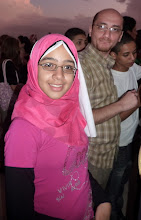
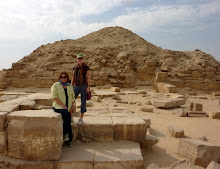
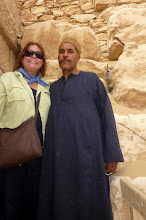
Kathy Cain, Karl Lorenz and I took a taxi downtown today at 4:45 pm for a 5:30 pm walk advertised in Cairo Listserv. You never know how traffic will be but Kathy was right, if we left early, it would only take ten minute to get there but if we left at 5:15 it would take 45 minutes. We didn't want to be late so we hung around the KFC for half an hour - our meeting point where eventually 14 of us took off trailing rather quickly, I must say, behind Mohamed our lively walking guide. The group was made up of a variety of people, a British couple who had been here a month and would be here for two years while Lara studied at AUC; some Cairo young men, hoping probably to meet American or British women, American professors, an Egyptian professor, and some students of different nationalities.
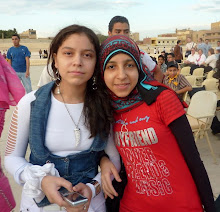
It was there that I started talking to a young Egyptian woman named Amira who is an arts journalist for Al Ahram weekly. I couldn't wait until I got home to look up her articles. Now, after I looked through the two weekly English papers I had at home, I found an article she had written about the area around Saqqara. She says she likes to have a theme, an off the beaten path kind of journalistic essay. She is a fabulous writer and a charismatic and interesting woman. She lives in Giza near the Pyramids. She had driven downtown to take the walk. She told me about the Hash House Harriers who sponsor hikes which she participates in because she loves hiking and enjoys nature. I'm tired now from the walk but I would like to elaborate later on this gem of a woman. She is putting me in touch with an NGO in Cairo where the women and girls sew clothing designed by her, clothing with an "edge" for better market appeal.
We decided to eat at the completion of the walk since she had been fasting all day and as we had ended up in Islamic Cairo right near the Khan el Khalili, we eventually found a place. Absolutely inexpensive, tammiya (aka felafel) was only 1.5 LE with bread. My water was 2.25 LE so for less than 4 LE I had a pretty good dinner = less than $1. I paid for dinner for three of us for 20 LE which is less than $4. Wow, it was fun experience and one of the nice things about our upstairs room was that I got to sit directly under an AC - it was especially humid in Cairo tonight.
We went to the Hussein Mosque so that Amira could pray. Naturally, I was thrilled to accompany here, a rare opportunity; I draped my scarf over my head and neck in preparation. The women pray in a separate area from the men in the mosque. She told me to keep my shoes with me (you have to take then off you see) before you enter a mosque. I sat next to Amira and meditated taking it all in, the women and girls in different kinds of clothing, different ways of praying. I told Amira that she looked like an angel in her white veil that she donned before we entered the mosque - she really did, she had such a beautiful glow about her. After she had finished praying she explained what the prayers meant, what she had said in her prayers and how Hussein was a brother of the prophet Mohamed so that going to this mosque is a reminder or an inspiration from being in a holy place where a saint is buried. The point in Islam is not to pray to Hussein or any other prophet, even Mohamed since one has a direct and personal connection to God but to be in a place where you feel more spiritual. While there, an older woman tried to give me some kofta (ground cooked lamb) to eat and luckily Amira was very politely saying no thank you for me. How sweet that was to offer me food in a mosque when she obviously didn't have much. Still, I was happy not to have to accept. Amira told me that she prays anywhere and we agreed that of course, you can pray while being out in nature, at home, really anywhere but she feels nostalgic after being away from home sometimes and going to a mosque is appealing because it is a tradition.
We grabbed a taxi to go back downtown to get Amira's car which she had parked relatively close to the KFC - she wanted to go to a kind of flea market on 26 July Street - not the one in Zamalek but one where second hand clothes are sold. This was like having a little treat, to buy herself something for the holiday. The traffic was absolutely nerve wracking but she drove with the skill of a seasoned Indy 500 driver. Anyone who complains about traffic in the U.S. has no idea how crazy it is here and how hard it is to cross a street with taxis, regular cars and motorbikes whizzing by. Some drivers will actually stop for pedestrians but not many. Amira told me that in winter you can get a fur coat for very little money in this area. I may just do that since I am going to the land of frostbite in January - Davos, Switzerland before I leave Cairo. We wandered around but didn't speak English because then, she explained, it was harder to bargain. She ended up with a bright yellow tank top and a pair of white pants trying on the pants while I felt like I was guarding the dressing room from straying male voyeurs. I so enjoyed this peak at the underbelly of Cairo with Amira of walking through crowds of the poor and lower middle class people out in the streets, looking at clothing, buying and eating packets of popcorn - it was more fulfilling to me than the walk. She's a Reiki practitioner too. Did you know that metal blocks chi and that wearing a watch blocks the energy which starts in the toes and goes up the hands? Well, I immediately took off my watch. I can use all the energy I can get! The walk, however from downtown Cairo to Islamic Cairo, was just what I needed in terms of exercise.
When I got home, I immediately took off my shoes, peeled off my sweaty clothes and took a well deserved shower in my luxe Fulbright apartment in Zamalek. I took the jasmine flowers threaded in a few loops out of my purse and put them in the living room. Life is good.
Saturday, September 19, 2009


Friday, September 18, 2009
Wednesday, September 16, 2009
Hanging around the house
Well, I am hanging around the apartment today but I got some work done like an overdue teaching observation and some other WCU work. I also was researching desert safari outfits for the Western Desert. I made some emails, answered others. Elnafeza papermaking facility in El Fostat is in desperate of funding. They do such humanitarian work, helping single women and the deaf mute community that it would be a shame if they had to close. Mohamed Nagy is a friend of Shayma (she seems to know everyone!) and he was so prompt in emailing me. I suggested to him that we organize an artist's papermaking workshop and book art session.
I will try to find some funding resources and talk to Fair Trade Egypt about them. FTE is now starting to buy some of their paper products and journals. During Ramadan they are open on Wednesdays from 10 am till the afternoon so starting on the 21st their hours will be longer and more days of the week.
I've been researching the rice straw burning phenomenon in Cairo which contributes to the Black Cloud over Cairo. It is already polluted and the rice straw burning contributes greatly to the problem. Of course, the diesel belching millions of taxis, microbuses and city buses besides the private cars are way too much for the air to assimilate. Luckily for me, I live in an area with more trees. It's not nearly enough. The problem is that recycling is very costly. So no recycling of plastic bottles which I contribute to on a daily basis. The paper is recycled into more paper but not everywhere. Basically, it occurs at APE in Moqqatam and at el Nafeza for some of their papermaking. The only recycling of plastic bottles is its reuse by the poor for their drinking water which we are told not to do in the U.S.
Beautiful Egypt has many problems and many people who want to help but not nearly enough funding. At least they include the arts in the curriculum but teaching really needs to be revamped. Some students who are poor are physically abused by teachers; others don't get passing grades even though they study and do pass. If you have money, teachers tend to pass students who are otherwise unprepared for exams and then they get the good jobs. A very unstable state of affairs. Shayma is an example of a student who fought hard for her education. But not everyone has such inner strength.
I hope to help in some way; as soon as my boxes of art supplies arrives, I will organize some children's art workshops in the area with Shayma. Lots of opportunities for that.
Tomorrow I will get myself up early and walk to the Agricultural Museum in Dokki - scenes of daily life, agricultural stuff and my favorite, animal mummies from ancient Egypt. Good night
I will try to find some funding resources and talk to Fair Trade Egypt about them. FTE is now starting to buy some of their paper products and journals. During Ramadan they are open on Wednesdays from 10 am till the afternoon so starting on the 21st their hours will be longer and more days of the week.
I've been researching the rice straw burning phenomenon in Cairo which contributes to the Black Cloud over Cairo. It is already polluted and the rice straw burning contributes greatly to the problem. Of course, the diesel belching millions of taxis, microbuses and city buses besides the private cars are way too much for the air to assimilate. Luckily for me, I live in an area with more trees. It's not nearly enough. The problem is that recycling is very costly. So no recycling of plastic bottles which I contribute to on a daily basis. The paper is recycled into more paper but not everywhere. Basically, it occurs at APE in Moqqatam and at el Nafeza for some of their papermaking. The only recycling of plastic bottles is its reuse by the poor for their drinking water which we are told not to do in the U.S.
Beautiful Egypt has many problems and many people who want to help but not nearly enough funding. At least they include the arts in the curriculum but teaching really needs to be revamped. Some students who are poor are physically abused by teachers; others don't get passing grades even though they study and do pass. If you have money, teachers tend to pass students who are otherwise unprepared for exams and then they get the good jobs. A very unstable state of affairs. Shayma is an example of a student who fought hard for her education. But not everyone has such inner strength.
I hope to help in some way; as soon as my boxes of art supplies arrives, I will organize some children's art workshops in the area with Shayma. Lots of opportunities for that.
Tomorrow I will get myself up early and walk to the Agricultural Museum in Dokki - scenes of daily life, agricultural stuff and my favorite, animal mummies from ancient Egypt. Good night
Tuesday, September 15, 2009
Monday, Monday
I went to visit Shayma Kamel today at her studio so I could see her latest works of art. She switched her decor from last year, just like me always changing furniture and rooms. Her studio is in one room with a lineoleum floor with plenty of room for her new work, very large canvases. She was currently working on some monoprints. Her work is so monumental despite the sometimes very small scale. Other canvases are 5' x 6'.
We talked, I played with her black cat Safety and took some pictures of him. He's pretty sociable like Shayma, was very happy to have me pet him, even his belly. She told me about her neighbor upstairs, Jennifer who graduated with her MA from the Royal College of Art in London. Jennifer is a painter but also has done other work, some film too. So we went up to her flat to visit and decided to all go to dinner together for the Iftar. Iftar is the meal that breaks the fast from Ramadan, when the sun goes down around 6 pm or so. We were joined by another friend, Atiya from Yemen. Atiya is getting married in Egypt in December so I have an invitation already. We were downtown and walked to an area with lots of local restaurants. The firest choice place was occupied so we walked down and around the block.
Dinner was kofta (grilled lamb like meatballs), okra in a delicious red sauce, rice, Egyptian bread, tahini, salad of tomatoes - I was too full to eat that and bottled water. Dinner for four people was 58 LE so less than $6. Amazing.
Today, Tuesday was our in country Fulbright orientation for scholars and students at the U.S. Embassy. A quick guide for safety, health, higher education in Egypt, tips from current Fulbright students, etc. I met Dominique, originally from Nebraska who has her BFA in printmaking and just finished her peace corps stint in Morocco. She was home for a month and then got the Fulbright. Shayma had told me about her. I met at the Iftar which we were bussed to (at the Citadel) a professor couple, Mostafa and Saraya who were both printmakers. Saraya teaches Art Education and told me of the UNESCO decision in 2007 to make mandatory art education for children because it has been proven that art, brain mapping and learning are all integrated. Harvard University, the Getty Center and two other places in the U.S. are pioneers in the field. So how come Egypt is so progressive in this when the State System of Higher Education is not? Why do the public schools in America drop funding for the arts especially the visual arts when UNESCO has this mandate? We are so backwards.
Mostafa and Saraya have invited me to visit their studio and home after Ramadan. I brought Dominique over to meet them. Mostafa is interested in c0ollaborating with me. Oh, I love Fulbright and the wonderful people who are alumni. Their daughter Dina is a graphic artist as well. Mostafa has done it all - woodblocks, etching, lithography, art books, etc. They were both so open and wonderful. I feel so lucky to have such great connections. There are two art stores in Zamalek with oil paint and other items made in Egypt that are quite good. They also know about El Nafeza, the papermaking workshop in el Fostat (Cairo).
I am going to need to make my art pieces for the exhibition very soon - I want to use Egyptian made paper, paints, etc. and theme too as my interpretation of Egypt through my eyes. A perfectly wonderful evening with good food, great music and Sufi dancing, and conversation with my Egyptian friends. Oh, Mostafa and Saraya also have a database of Nubian handicrafts from a project they did. I love the spirit of the people I meet, so generous and gracious. Just wanted to post this to let everyone know how great things are going More later and will post pics tomorrow.
We talked, I played with her black cat Safety and took some pictures of him. He's pretty sociable like Shayma, was very happy to have me pet him, even his belly. She told me about her neighbor upstairs, Jennifer who graduated with her MA from the Royal College of Art in London. Jennifer is a painter but also has done other work, some film too. So we went up to her flat to visit and decided to all go to dinner together for the Iftar. Iftar is the meal that breaks the fast from Ramadan, when the sun goes down around 6 pm or so. We were joined by another friend, Atiya from Yemen. Atiya is getting married in Egypt in December so I have an invitation already. We were downtown and walked to an area with lots of local restaurants. The firest choice place was occupied so we walked down and around the block.
Dinner was kofta (grilled lamb like meatballs), okra in a delicious red sauce, rice, Egyptian bread, tahini, salad of tomatoes - I was too full to eat that and bottled water. Dinner for four people was 58 LE so less than $6. Amazing.
Today, Tuesday was our in country Fulbright orientation for scholars and students at the U.S. Embassy. A quick guide for safety, health, higher education in Egypt, tips from current Fulbright students, etc. I met Dominique, originally from Nebraska who has her BFA in printmaking and just finished her peace corps stint in Morocco. She was home for a month and then got the Fulbright. Shayma had told me about her. I met at the Iftar which we were bussed to (at the Citadel) a professor couple, Mostafa and Saraya who were both printmakers. Saraya teaches Art Education and told me of the UNESCO decision in 2007 to make mandatory art education for children because it has been proven that art, brain mapping and learning are all integrated. Harvard University, the Getty Center and two other places in the U.S. are pioneers in the field. So how come Egypt is so progressive in this when the State System of Higher Education is not? Why do the public schools in America drop funding for the arts especially the visual arts when UNESCO has this mandate? We are so backwards.
Mostafa and Saraya have invited me to visit their studio and home after Ramadan. I brought Dominique over to meet them. Mostafa is interested in c0ollaborating with me. Oh, I love Fulbright and the wonderful people who are alumni. Their daughter Dina is a graphic artist as well. Mostafa has done it all - woodblocks, etching, lithography, art books, etc. They were both so open and wonderful. I feel so lucky to have such great connections. There are two art stores in Zamalek with oil paint and other items made in Egypt that are quite good. They also know about El Nafeza, the papermaking workshop in el Fostat (Cairo).
I am going to need to make my art pieces for the exhibition very soon - I want to use Egyptian made paper, paints, etc. and theme too as my interpretation of Egypt through my eyes. A perfectly wonderful evening with good food, great music and Sufi dancing, and conversation with my Egyptian friends. Oh, Mostafa and Saraya also have a database of Nubian handicrafts from a project they did. I love the spirit of the people I meet, so generous and gracious. Just wanted to post this to let everyone know how great things are going More later and will post pics tomorrow.
Saturday, September 12, 2009
Wissa Wassef Art Center
Ready for an adventure, I take a metered taxi to the HSBC bank to get my ATM card. I'm early, the bank doesn't open untl 9:30 am. But no, the bank is closed today and open tomorrow. Oh well, it was a 5 LE trip. So I look for another meter taxi and off I went. But, you guessed it, my taxi driver spoke not a lick of English and had no idea how to read the map I showed him. When I said Marriott, I thought surely everyone knows the Cairo Marriott. Evidently not. I even had my handly compass out knowing that we were supposed to go south. After a 5 LE fare, we were back where we started and he acted like it was all new to him. Getting more exasperated by the minute, I made him stop for directoins. He finally dropped me off at the other side of the Marriott. Shayma was coming and I didn't want to be late for her. Although the meter showed 12 LE I gave him 5 and said that's all you get. It was so irritating but then I thought, yes well, you sometimes get so lost in Philadelphia that you enter a time warp of altered dimensions. Maybe I should give him the benefit of the doubt. However this is me thinking many hours later. I was only 5 minutes late even after circling Zamalek for half an hour.
But the real adventure begins when we embark on our journey to Wissa Wassef around 10 am. First a meter taxi to Sadat Metro Station - only 1 LE each and it take far less time than a taxi since we will be going to the Giza Station Metro. We take the women's car which is clearly marked (in case you can't read Arabic) in red with the symbol of a woman in a skirt. Very clean station and car, not like you might encounter in other places like New York or some parts of Paris. We then take a microbus - another first for me. Luckily, the bus isn't too crowded and it is only 3 LE for both of us. We get to a halfway area (toward Saqqara) before we transfer to another microbus which will take us to the village of Harrinayya. After that, it is a short walk to the Art Center.
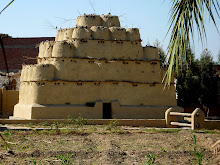
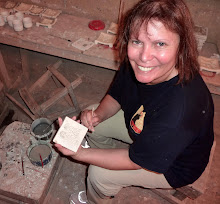
We are greeted by Alfons, one of the art center's managers who is a wonderful guide and storyteller of this amazing complex. It started around 1953 as the dream of Ramses Wissa Wassef and his wife Suzanne to provide a creative outlet and minimal training in weaving to children of the village, particularly young girls. It is a mud brick complex with open studios. The women (primarily) who work there have keys to the loom rooms so they can set their own hours since most are housewives with families to take care of as well. In addition to wool/cotton tapestry weavings and cotton/cotton weavings, other studios are devoted to batik painting and pottery. Suzanne Wissa Wassef is a potter, she has one assistant handling the clay preparation and making glazes. Other than that, she creates all the plates, vases, and other items for sale. I set aside two coffee mugs made of Nile clay from Aswan with blue and white markings.
Alfons takes Shayma and myself on a tour of the studios where we meet a total of six women and one man. Most are second generation weavers. Do do meet a first generation weaver who started in 1954 at the age of eight. Another woman started in the 1960s at the age of fourteen. Their work is astonishing, woven sideways on the looms in designs that are entirely freehand. The weavings are created with yarns dyed in natural colors. In fact, Alfons went to the garden and dug around to show me the rose madder root used to create deep reds and softer oranges. Most of the colors are grown in the complex gardens - Ramses Wissa Wassef wanted his studios to be self sufficient. Only indigo and cochineal are imported. However, the dyes used for the batik work are chemical dyes that can be used in cold water because of the process involved. Even the batik work is free hand with designs "drawn" in hot wax on the raw material of cotton which comes from Egypt. Silk isn't used because it is not native to the country.
But the real adventure begins when we embark on our journey to Wissa Wassef around 10 am. First a meter taxi to Sadat Metro Station - only 1 LE each and it take far less time than a taxi since we will be going to the Giza Station Metro. We take the women's car which is clearly marked (in case you can't read Arabic) in red with the symbol of a woman in a skirt. Very clean station and car, not like you might encounter in other places like New York or some parts of Paris. We then take a microbus - another first for me. Luckily, the bus isn't too crowded and it is only 3 LE for both of us. We get to a halfway area (toward Saqqara) before we transfer to another microbus which will take us to the village of Harrinayya. After that, it is a short walk to the Art Center.
We are greeted by Alfons, one of the art center's managers who is a wonderful guide and storyteller of this amazing complex. It started around 1953 as the dream of Ramses Wissa Wassef and his wife Suzanne to provide a creative outlet and minimal training in weaving to children of the village, particularly young girls. It is a mud brick complex with open studios. The women (primarily) who work there have keys to the loom rooms so they can set their own hours since most are housewives with families to take care of as well. In addition to wool/cotton tapestry weavings and cotton/cotton weavings, other studios are devoted to batik painting and pottery. Suzanne Wissa Wassef is a potter, she has one assistant handling the clay preparation and making glazes. Other than that, she creates all the plates, vases, and other items for sale. I set aside two coffee mugs made of Nile clay from Aswan with blue and white markings.
Alfons takes Shayma and myself on a tour of the studios where we meet a total of six women and one man. Most are second generation weavers. Do do meet a first generation weaver who started in 1954 at the age of eight. Another woman started in the 1960s at the age of fourteen. Their work is astonishing, woven sideways on the looms in designs that are entirely freehand. The weavings are created with yarns dyed in natural colors. In fact, Alfons went to the garden and dug around to show me the rose madder root used to create deep reds and softer oranges. Most of the colors are grown in the complex gardens - Ramses Wissa Wassef wanted his studios to be self sufficient. Only indigo and cochineal are imported. However, the dyes used for the batik work are chemical dyes that can be used in cold water because of the process involved. Even the batik work is free hand with designs "drawn" in hot wax on the raw material of cotton which comes from Egypt. Silk isn't used because it is not native to the country.
Friday, September 11, 2009
How Can It Be Friday Already?
I hadn't realized how many days had passed since my last blog. I guess I had been emailing and chatting and Skypeing all of my news but to only a few people. Tuesday, I went to the Fulbright office to turn in my ugggglllly passport photo. I had a conversation with Hend in the office there and she said all of those photos are bad and her driver's license is awful. What is your idea about this? My sister Loretta says she looks like the undead or a zombie which are actually the same thing I suppose. I think it's because they shoot against a start wall with overly bright lights. The camera is set up on a tripod just below a person's face so it shows all the shadows and lines and starkness and double chins even if yours isn't bad. Kind of like trying on bathing suits in front of a dressing room mirror that is brightly lit with fluorescent lights, which, if you don't know, shows all every inch of cellulite! My method for taking more flattering pictures is to have the camera pointed down from above - stand up on a chair if you have to. I learned this trick from a photographer journalist when I was interviewed in 2003 for the Philadelphia Inquirer. Oh well, it cost less than $2 for four. They told me at the office that it couldn't be a digital print but that's exactly what the Kodak store on 26 July Street did. I could have just as easily stood in front of my own white wall here.
I gave them my passport because Yousri was going to the Mugamma to get our resident visas - you need one of these in case you stay over 30 days. My metered taxi driver this time spoke not a lick of English. No one has heard of Amer Street. I made him ask as he drive all over the place but still it cost 11 LE (which I'm going to be using instead of EGP - L is the symbol for pound as in British pounds). My taxi driver on the way back cost me only 6 LE. Go figure. Passing from one zone to the other seems to be the problem in terms of knowing streets. Of course, my lack of Arabic fluency is also problematic.
After that, I went to Egypt Craft Center to ask for May but she no longer worked there. It was Nadia, I was informed who could help me tomorrow morning around 9 am. I thought well, I'll get in a good walk to the Alpha Market for you guessed it, more water. I had my backpack, the one Fulbright gave me which was handy for three bottles but it weighed a lot. Home then, and watched a bunch of movies while working on various things.
Wednesday morning - I actually woke up at 7:30 am, the time I had told myself to wake up and got there a little early. Nadia was wonderful, she had met me last year. Nadia is from Upper Egypt which as you might know is southern Egypt. She had a baby last year which I congratulated her for, a boy. Anyway, since May el Sadek moved on, Nadia now is associate manager. Between the two of us, I got my list more updated. Sometimes there aren't phone numbers or even streets. In the Fayum, for example, I go to the village of Tunis and ask for Abd Sattar. Everyone knows him.
After this, I saw an electronics store and wanted to get a converter for my mini laptop Dell which it turns out, one doesn't need because laptops are made in dual voltage. I did get the pieces to change the flat prongs of the U.S. to the round pins. Then it was home again. and I called Shayma to see how she was. She asked to come over the next day so she could call the Embassy for her visa appointment. It is scheduled for Tuesday the 15th. She wants to make it for three months so that she can visit a friend in New York and a friend in Canada. I looked up Canadian requirements for her, and she does need a visa to visit Montreal or anywhere in Canada.
Shayma is helping me with some essential Arabic phrases like please, right, left, here, thank you. We had a nice time visiting. Wednesday night, I stayed up really late past 1 am and didn't get up until noon. Then it takes me so long to get moving that by the time I looked up the bank's hours, it had closed. During Ramadan, banks have shorter hours and are totally closed on Fridays. I will have to wait until Saturday, tomorrow, to get my ATM card for my Egyptian account at HSBC.
Tonight, Shayma is coming over so we can go for a walk in the area. She's spending the night so that she can help me call Wissa Wassef in the morning, I am feeling a bit deprived from seeing art and doing my project. That would be a good start. I found that one of my workshops run by a mother and daughter who make candles are no longer part of FTE. I promise to be better about blogging. Just a few new photos to post.
I gave them my passport because Yousri was going to the Mugamma to get our resident visas - you need one of these in case you stay over 30 days. My metered taxi driver this time spoke not a lick of English. No one has heard of Amer Street. I made him ask as he drive all over the place but still it cost 11 LE (which I'm going to be using instead of EGP - L is the symbol for pound as in British pounds). My taxi driver on the way back cost me only 6 LE. Go figure. Passing from one zone to the other seems to be the problem in terms of knowing streets. Of course, my lack of Arabic fluency is also problematic.
After that, I went to Egypt Craft Center to ask for May but she no longer worked there. It was Nadia, I was informed who could help me tomorrow morning around 9 am. I thought well, I'll get in a good walk to the Alpha Market for you guessed it, more water. I had my backpack, the one Fulbright gave me which was handy for three bottles but it weighed a lot. Home then, and watched a bunch of movies while working on various things.
Wednesday morning - I actually woke up at 7:30 am, the time I had told myself to wake up and got there a little early. Nadia was wonderful, she had met me last year. Nadia is from Upper Egypt which as you might know is southern Egypt. She had a baby last year which I congratulated her for, a boy. Anyway, since May el Sadek moved on, Nadia now is associate manager. Between the two of us, I got my list more updated. Sometimes there aren't phone numbers or even streets. In the Fayum, for example, I go to the village of Tunis and ask for Abd Sattar. Everyone knows him.
After this, I saw an electronics store and wanted to get a converter for my mini laptop Dell which it turns out, one doesn't need because laptops are made in dual voltage. I did get the pieces to change the flat prongs of the U.S. to the round pins. Then it was home again. and I called Shayma to see how she was. She asked to come over the next day so she could call the Embassy for her visa appointment. It is scheduled for Tuesday the 15th. She wants to make it for three months so that she can visit a friend in New York and a friend in Canada. I looked up Canadian requirements for her, and she does need a visa to visit Montreal or anywhere in Canada.
Shayma is helping me with some essential Arabic phrases like please, right, left, here, thank you. We had a nice time visiting. Wednesday night, I stayed up really late past 1 am and didn't get up until noon. Then it takes me so long to get moving that by the time I looked up the bank's hours, it had closed. During Ramadan, banks have shorter hours and are totally closed on Fridays. I will have to wait until Saturday, tomorrow, to get my ATM card for my Egyptian account at HSBC.
Tonight, Shayma is coming over so we can go for a walk in the area. She's spending the night so that she can help me call Wissa Wassef in the morning, I am feeling a bit deprived from seeing art and doing my project. That would be a good start. I found that one of my workshops run by a mother and daughter who make candles are no longer part of FTE. I promise to be better about blogging. Just a few new photos to post.
Subscribe to:
Posts (Atom)