Yes, it's true. I was walking along 26 July Street on an infrequent walk, looked up at the sky which had puffy white clouds and above them a black series of clouds that looked like the black mist in Lost. You know, the one that swallowed Echo. The rain lasted only about 10 minutes but the sky tossed down about 1/10 of an inch. So that's my weather report!
I did a survey of the sidewalks in my neighborhood and the heavily trafficked 26 July Street the other day on my way to Alpha Market. In the light of day, one can watch for mishaps waiting to happen. In the dark, forget it! Pipes sticking up randomly (at least to me though they must have some purpose other than maiming visitors and residents), square holes about 12" x 12" usually partially filled with sand and/or trash like plastic bottles and paper and missing chunks of the 6 sided cement tiles and other random holes and protuberances. Then there are the high sidewalks with depressed driveways that you have to step down into and out of to continue on your way. No wonder Cairenes walk on the blacktop streets. But then, you have to make sure a taxi or other car's driver doesn't run over your foot. And believe me, it happens. I've gotten pretty good at crossing the street but downtown, it is treacherous. I did a little photo shoot of my walk - in real life, it looks worse, the photos make it seem not so bad but that's up to you to decide.
I find foam core at the art store on Ibrahim Mohamed Street near the art school. Lots of girls carrying their black portfolios and other art supplies, more than male students. So I wondered if the young women found that art was a safe major to pursue since most will get married and have families. I had one of those days where I would see a couple - Egyptian guy dressed in western wear with his wife all covered up, head to toe, only eyes showing and got annoyed. Some days it makes me really irritable and I want to yell at the men. The argument always is that a married woman is "protected" from the eyes of other men. Yes, I can see that but why are the men who might be ogling her so 1950s construction worker like in their patriarchal male chauvinist attitudes. Oh, the argument goes, they are frustrated. So what, do what men do, no not cheat on their wives or jump on foreign women, respect your Egyptian sisters. Really!
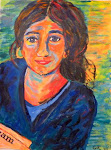
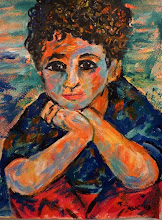
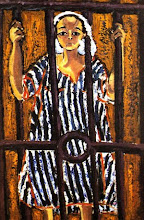
Anyway, it made me really happy to find the foam board rather than the heavy masonite backing that Mr. Helmy used in my last framed work. I am nearly finished with the backgrounds of two large 60 x 80 cm. acrylic paintings (background of rusty door with blue, white, yellow and some black paint that I photographed in Al Arish last Thursday. Then, I'm going to do a semi Ida Applebroog thing of having three 5" x 5" portraits of Bedouin women and children using the transfer technique on the bottom. I finally got the yellow paint with substantial drips the way I wanted. I've been working on this for three days now. It will take the last treatment a day or two to fully dry before the transfer. I have to have them ready by December 15th for a December 27th International Exhibition that Helwan University is sponsoring curated by Dr. Soheir Osman.
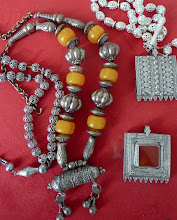
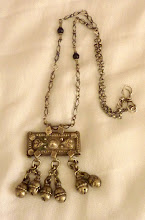
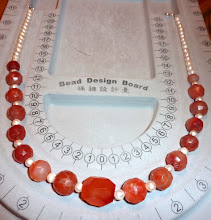
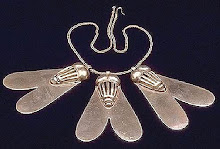
Sunday I went to the Khan Khalili to see if I could find some old beads. Note to self: never trust anyone who takes you to a shop. Prices are inflated because they get a cut of what you buy. They are all flattery and niceness until you find that the old beads you happily chose are 40 LE a gram, Even silver isn't more than 5 LE a gram though what's his name said it was 8 LE. I ended up culling my lovely collection of coral, turquoise, lapis and amber to four small pieces which I am embarrassed to admit, were very costly. If I had bought my small pile, they were going to charge me 6700 LE. Are they insane? No they thought I was. Beads do not cost that much. So I am back to ebay buying what I want at very reasonable prices. In case you don't know, 6700 LE is over $1000. I could nearly buy an ounce of gold for that! Anyway, lesson learned.
I'll post pics of the beads, my painting and the sidewalk horrors.
Monday, December 7, 2009


Tuesday, December 1, 2009
Remembering Jeanette
My sister-in-law Jeanette, wife to my brother Joe in Colorado Springs, died Sunday night and I wanted to express my sadness of her death. She was diagnosed in the summer with a bilateral brain tumor which she didn't know she had until she took a nap and didn't wake up for over three weeks after her surgery. I met Jeanette when I was around 19 years old. We worked at a nursing home and she taught me how to take care of patients. Then my brother started working there, her pursued her despite objections from her mother, they married and were together for 37. They have two children, Gina (Regina) a working mother of two sons, and Ricky (Richard) who is in his second year of law school in New Mexico.
My brother Joe was such a good husband and provider. He took care of Jeanette himself with a little help from some friends and hospice at the end. A man like him is hard to find these days. Aside from her hospital stays after her two surgeries, she was at home.
Jeanette was a veteran shopper, she loved all sorts of things and kind of reminded me of myself alittle. My sister Loretta and I went to visit Joe and Jeanette this past August and helped Joe clean up a bit - all those clothes with tags still on etc. I hadn't seen my brother for many years. I got to meet my niece and nephew for the first time - they are both amazing. Joe is really close to his grandsons which will really help in the sad months to follow. Her funeral will be December 11th and she will be buried in the cathedral in the Queen of Angels side of the columbarium. Joe said she would have liked that.
Dis Manibus Jeanette, Rest in Peace.
My brother Joe was such a good husband and provider. He took care of Jeanette himself with a little help from some friends and hospice at the end. A man like him is hard to find these days. Aside from her hospital stays after her two surgeries, she was at home.
Jeanette was a veteran shopper, she loved all sorts of things and kind of reminded me of myself alittle. My sister Loretta and I went to visit Joe and Jeanette this past August and helped Joe clean up a bit - all those clothes with tags still on etc. I hadn't seen my brother for many years. I got to meet my niece and nephew for the first time - they are both amazing. Joe is really close to his grandsons which will really help in the sad months to follow. Her funeral will be December 11th and she will be buried in the cathedral in the Queen of Angels side of the columbarium. Joe said she would have liked that.
Dis Manibus Jeanette, Rest in Peace.
Monday, November 30, 2009
Camping in the White Desert
I just got back yesterday from four days, three nights camping in the White Desert. It is situated southwest of Cairo in between the Bahariya oasis (where the golden mummies were found) and the Farafra oasis. It takes quite a long time to reach Bahariya (nearly five hours) which we got to by a private Badawiya Expedition bus. We met at the British Council in Agouza just across the Nile from Zamalek. Four Fulbrighters including myself plus Jamie, a Brit who works as head honcho for Oxfam here in Cairo and Mona and Sharifa, mother and daughter. Mona is the owner of Nefertari, a natural cosmetics company now in its 10th year with stores in Zamalek and Maadi. I had made an expedition to Nefertari as I had read about it in our Cairo book; Oxfam and I have acquainted for years from my time in England and Oxford.
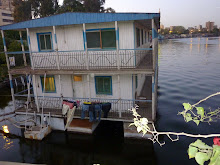
Once the police had copied our passports at the Bahariya oasis entrance and we looked at various handicrafts - the best of which were the sheep's wool blankets, nearly as soft as mohair or cashmere - Jamie bought a camel hair blanket which he will use as a rug on his rental apartment on a houseboat across the river from me - we changed transport to our 4 x 4 jeep. The desert road grew progressively bumpier with long long stretches of desert as far as the eye could see and beyond. It is said that there is 700,000 miles of desert and we had barely touched the fringes.
From Bahariya, we went on to our campsite, tired and hungry.
After some debate as to whether the five of us would all sleep in a large tent, we finally moved in. Jamie obtained the mattresses - thin pads of fabric covered foam and so the men were on one side of reed covered tent space while Joelle and I occupied the other side. Luckily I had brought a sheet as the blankets were scratchy camel wool. It was cold too as deserts are wont to be, warm in the daytime. We joined around 40 others - Egyptian families with rambunctious children and our Bedouin male hosts in charge of setting up tents, making our meals and driving us around. That night - Thanksgiving - we had grilled chicken on a metal grille directly over a fire, potatoes cooked in a large pot with with a tomato base, rice, chopped up tomatoes and cucumbers and assorted things to drink, nonalcoholic of course.
There was a three sided covered area to eat, again with the reed mats and the Egyptian families were at one side and we on the other. It was pretty much a quiet night and we retired fairly early. There were two porta-potties, one ostensibly for showering but really, that was an impossibility. Thankfully, I had brought facial wet wipes and body wipes and got myself ready for three more days of non-hair washing. There was a bit of snoring but I had brought ear plugs and proceeded to shiver myself to sleep.
Naturally, nature called and as the actual toilets were quite a walk in the dark - there was a 3/4 moon though - I looked around for anyone awake and nearsightedly saw none - walked or rather wobbled on the sand and saw that a 4 x 4 truck was parked conveniently not so far away from our square tent. I didn't really look into the truck but thankfully got behind it, squatted and peed with great relief. Once done, I looked up into the straw strewn night sky with too numerous to count stars, I have no idea what time it was - maybe 2 am. I'm glad I did see the sky because on the next two nights I woke up closer to dawn and couldn't see the abundance of stars as on the first night.
More later - for our second day's adventure.
Once the police had copied our passports at the Bahariya oasis entrance and we looked at various handicrafts - the best of which were the sheep's wool blankets, nearly as soft as mohair or cashmere - Jamie bought a camel hair blanket which he will use as a rug on his rental apartment on a houseboat across the river from me - we changed transport to our 4 x 4 jeep. The desert road grew progressively bumpier with long long stretches of desert as far as the eye could see and beyond. It is said that there is 700,000 miles of desert and we had barely touched the fringes.
From Bahariya, we went on to our campsite, tired and hungry.
After some debate as to whether the five of us would all sleep in a large tent, we finally moved in. Jamie obtained the mattresses - thin pads of fabric covered foam and so the men were on one side of reed covered tent space while Joelle and I occupied the other side. Luckily I had brought a sheet as the blankets were scratchy camel wool. It was cold too as deserts are wont to be, warm in the daytime. We joined around 40 others - Egyptian families with rambunctious children and our Bedouin male hosts in charge of setting up tents, making our meals and driving us around. That night - Thanksgiving - we had grilled chicken on a metal grille directly over a fire, potatoes cooked in a large pot with with a tomato base, rice, chopped up tomatoes and cucumbers and assorted things to drink, nonalcoholic of course.
There was a three sided covered area to eat, again with the reed mats and the Egyptian families were at one side and we on the other. It was pretty much a quiet night and we retired fairly early. There were two porta-potties, one ostensibly for showering but really, that was an impossibility. Thankfully, I had brought facial wet wipes and body wipes and got myself ready for three more days of non-hair washing. There was a bit of snoring but I had brought ear plugs and proceeded to shiver myself to sleep.
Naturally, nature called and as the actual toilets were quite a walk in the dark - there was a 3/4 moon though - I looked around for anyone awake and nearsightedly saw none - walked or rather wobbled on the sand and saw that a 4 x 4 truck was parked conveniently not so far away from our square tent. I didn't really look into the truck but thankfully got behind it, squatted and peed with great relief. Once done, I looked up into the straw strewn night sky with too numerous to count stars, I have no idea what time it was - maybe 2 am. I'm glad I did see the sky because on the next two nights I woke up closer to dawn and couldn't see the abundance of stars as on the first night.
More later - for our second day's adventure.
Monday, November 23, 2009
My Next International Exhibition
I met with Professor Soheir Osman today at the Faculty of Applied Arts, Helwan University in Dokki. She is such a wonderful woman and so generous with her time in the midst of all the work she has to do as Dean, teaching, curating an International Exhibition and her upcoming daughter's wedding. She had compiled a CD with 40-50 Egyptian women artists and their work; had an exhibition catalogue for me of women artists from Helwan University, and several other articles of information and images. I am so touched by her generosity. Dr. Taha Hussein had called her without notice when at our meeting a couple of weeks ago, I had mentioned that I was interested in interviewing and documenting women artists in Egypt. Dr. Hussein felt that my overly ambitious plan of visiting those 35+ workshops all over Egypt was a bit much for me to accomplish in 4 1/2 months. He's right - what with a whole month of Ramadan when I first arrived - and the brutally hot and humid weather - plus this new holiday tha coincides with our Thanksgiving - difficult to say the least.
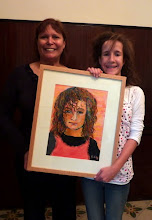
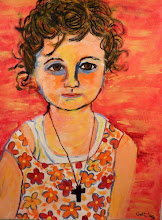
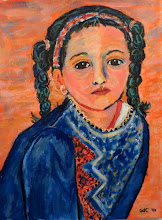
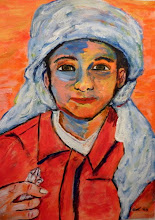
However, I have an appointment with her tomorrow to drop off a CD with my c.v., photo portrait of myself and a photo of one of my paintings, I chose the Bedouin Girl who wasn't exhibited at the Al Bab Gallery at the Cairo Opera House complex. However, I am now working on a larger canvas which I sketched out in charcoal for a painting. I can exhibit two paintings so #1 is a group of three Bedouin children, two girls and a boy and the other one will be of Coptic Egyptian children but I haven't yet decided on which composition to do. I have until December 15th to bring the paintings in.
Tomorrow at 10 am I drop off the CD for the publisher - I am just under the wire for the catalogue. Did I mention that Dr. Osman asked if I were interested in exhibiting for their December 27th International Exhibition. She showed me who was exhibiting and the countries represented: Palestine, Oman, Canada, England, Australia, Holland, etc. and I (MOI) am the American participant. Wow! Dominique says that my stars are apparently lined up in the correct position for me. I will go to Soheir's studio on Sunday right after our Desert trip and take Dominique with me if she can go. We are supposed to get to Agouza at 6 pm and I thought we were getting back earlier as my appointment is 6 pm at her house/studio right on the Corniche de Nil. So I will have to tell her about the later time.
Tomorrow at noon, I will meet with Shayma to conduct interviews with the women who work on crafts at the All Saints Episcopal Church. Susie - an Egyptian woman who is a survivor of bad burns on her face as far as I could see, speaks some English and I will go to see her and the women. Finally, I have gotten more energetic (I am forcing myself and it is paying off) as the time for me in Egypt is winding down. I could do well here, I love how helpful my Egyptian friends are and I know now that I will have to apply for the WCU PASSHE grant for this coming summer. I want to study Arabic in Egypt and then I will be ready to apply for the Fulbright Hays Faculty Research Grant. So this is all for now, just wanted to catch up on today. I still have to fill in the blanks from Saturday's trip.
However, I have an appointment with her tomorrow to drop off a CD with my c.v., photo portrait of myself and a photo of one of my paintings, I chose the Bedouin Girl who wasn't exhibited at the Al Bab Gallery at the Cairo Opera House complex. However, I am now working on a larger canvas which I sketched out in charcoal for a painting. I can exhibit two paintings so #1 is a group of three Bedouin children, two girls and a boy and the other one will be of Coptic Egyptian children but I haven't yet decided on which composition to do. I have until December 15th to bring the paintings in.
Tomorrow at 10 am I drop off the CD for the publisher - I am just under the wire for the catalogue. Did I mention that Dr. Osman asked if I were interested in exhibiting for their December 27th International Exhibition. She showed me who was exhibiting and the countries represented: Palestine, Oman, Canada, England, Australia, Holland, etc. and I (MOI) am the American participant. Wow! Dominique says that my stars are apparently lined up in the correct position for me. I will go to Soheir's studio on Sunday right after our Desert trip and take Dominique with me if she can go. We are supposed to get to Agouza at 6 pm and I thought we were getting back earlier as my appointment is 6 pm at her house/studio right on the Corniche de Nil. So I will have to tell her about the later time.
Tomorrow at noon, I will meet with Shayma to conduct interviews with the women who work on crafts at the All Saints Episcopal Church. Susie - an Egyptian woman who is a survivor of bad burns on her face as far as I could see, speaks some English and I will go to see her and the women. Finally, I have gotten more energetic (I am forcing myself and it is paying off) as the time for me in Egypt is winding down. I could do well here, I love how helpful my Egyptian friends are and I know now that I will have to apply for the WCU PASSHE grant for this coming summer. I want to study Arabic in Egypt and then I will be ready to apply for the Fulbright Hays Faculty Research Grant. So this is all for now, just wanted to catch up on today. I still have to fill in the blanks from Saturday's trip.
Sunday, November 22, 2009
Wadi Heitan Valley of the Whales
Saturday was an all day trip to the Valley of the Whales - a long ride by Land Cruiser 4x4s past Fayoum oasis. In 2005 skeletons of 39-43 million year old marine mammals were discovered throughout the desert floor close to Wadi Rayan. I'm not sure how truly accurate the claim is that these whales with vestigial limbs are the "missing link" between land based animals and ocean based animals. I thought it was the other way around that sea creatures gave rise to amphibians to truly land locked types which eventually became the might dinosaurs.
Well, be that as it may, it was still remarkable. What I loved were the "coins" small dime to quarter sized fossils which were once prehistoric single celled creatures around 43 million years ago. I collected a bunch of these from Wadi Ryan as there are millions of them and the geologist at the Valley of the Whales said that we could bring these home. Naturally, my over zealous collecting resulted in a little pouchful and I will have to cull my geological specimens before I go home. I was thinking that they would make interesting earrings but then, I would have to find some way to drill small holes in them - a talent beyond my capabilities at this time.
It was a very long day! We had a great lunch, albeit on the cold side, of chicken, large haunch of lamb and the usual rice with raisins, salad, etc. Our 4x4 jeeps were very axle impaired what with the bumpiness of the road but I made it home relatively intact.
Well, be that as it may, it was still remarkable. What I loved were the "coins" small dime to quarter sized fossils which were once prehistoric single celled creatures around 43 million years ago. I collected a bunch of these from Wadi Ryan as there are millions of them and the geologist at the Valley of the Whales said that we could bring these home. Naturally, my over zealous collecting resulted in a little pouchful and I will have to cull my geological specimens before I go home. I was thinking that they would make interesting earrings but then, I would have to find some way to drill small holes in them - a talent beyond my capabilities at this time.
It was a very long day! We had a great lunch, albeit on the cold side, of chicken, large haunch of lamb and the usual rice with raisins, salad, etc. Our 4x4 jeeps were very axle impaired what with the bumpiness of the road but I made it home relatively intact.
Tuesday, November 17, 2009
Al Bab Gallery & Cairo Symphony
Saturday night's art gallery opening was well attended even by the American Ambassador She didn't seem all that interested in me but was very courteous to my fellow Egyptian art colleagues. I got to meet Gazbia Sirry, the petite 80 something dynamo whose passion for painting has not ceased. She said her next showing of new work is slated for February 2010. Unfortunately, I won't make the opening but maybe her work will still be up when I return to Egypt for my presentation at Alexandria University March 2 to celebrate Women's History Month. I was really thrilled with the attendance of my Fulbright colleagues: Karl, Kathy and the kids, Karl Schaefer, Zohair, Dominique of course, Sussan and many others. Thank you all for coming. Shayma brought me a beautiful bouquet of flowers - I felt like a rock star. Also my friends from the jewelry class of Women's Association in Zamalek. So impressed with the fact that they braved the horrendous traffic as it was the Egypt-Algeria finals. I loved seeing my friend Mounira because it's been a year and she has been so busy with with conferences in England, Austria and the U.S. just in the last couple of months.
Here are the artist's works that I felt were pretty fabulous: Gazbia Sirry, Khaled Hafez, Gamal Lamie, and Mostafa Razzaz. I have to get to the gallery tomorrow to take some photos as there were so many people there, I didn't get around to it. I want my readers to see it too. The other thing I wanted to mention was the ride home. It was difficult because all the taxis were full of people either going downtown where all the action was or from October 6 City that the U.S. Embassy issued a warning about since people get pretty worked up over soccer or football as they call it here. The rematch is tomorrow so more traffic woes. Anyway, we were finally picked up by a taxi whose wife and young daughter (with her face painted with Egypt's colors) were riding in the front seat. The photo I am posting will shock you as the mother had the baby daughter perched outside the window as if she was a dog needing air. I had given the child a few flowers from my bouquet and she, just like a femme fatate, had them in her mouth.
I just finished reading Taxi about taxi drivers in Egypt. The real life stories never cease to amaze me in terms of my own experiences. That child could have been decapitated at any time or at last made limbless as she put her little arm to pat the van next to the taxi. Sigh.
Here are the artist's works that I felt were pretty fabulous: Gazbia Sirry, Khaled Hafez, Gamal Lamie, and Mostafa Razzaz. I have to get to the gallery tomorrow to take some photos as there were so many people there, I didn't get around to it. I want my readers to see it too. The other thing I wanted to mention was the ride home. It was difficult because all the taxis were full of people either going downtown where all the action was or from October 6 City that the U.S. Embassy issued a warning about since people get pretty worked up over soccer or football as they call it here. The rematch is tomorrow so more traffic woes. Anyway, we were finally picked up by a taxi whose wife and young daughter (with her face painted with Egypt's colors) were riding in the front seat. The photo I am posting will shock you as the mother had the baby daughter perched outside the window as if she was a dog needing air. I had given the child a few flowers from my bouquet and she, just like a femme fatate, had them in her mouth.
I just finished reading Taxi about taxi drivers in Egypt. The real life stories never cease to amaze me in terms of my own experiences. That child could have been decapitated at any time or at last made limbless as she put her little arm to pat the van next to the taxi. Sigh.
Garbage Collector's Village
The Association for the Protection of the Environment (APE), Mansheyet Nasser, Mokkatam, Cairo, Egypt.
P.O. Box 32 Qal’a, Cairo, Mansheyet Nasser, Mokkatam
Telephone: Nicole Saad at 012-241-0522
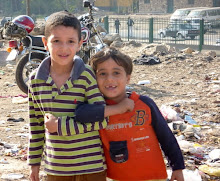
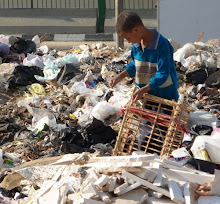
Getting to the Association for the Protection of the Environment (APE) near the hills of Mokkatam, Cairo is a difficult if not impossible task with local transportation. Everyone in Egypt knows where the Garbage City location is yet few have ever visited the site. Additionally, not many residents outside of Mokkatam or visitors to Egypt know about APE though it is a model concept for recycling and for raising the esteem and livelihood of young and married Egyptian women. APE is close to the Coptic monastery chapels of St. Simon the Tanner. You should engage a driver who speaks Arabic (and who is willing to take you there) making frequent stops to ask directions, and a less than perfect sense of smell. You are, after all, going to a neighborhood where 7000 tons of garbage is dumped daily from over 20 million inhabitants of Cairo. You will know when you enter the “garbage collectors” village by the site and smell of piles of garbage, paper, styrofoam, plastic and other bits of flotsam and jetsam. Mahsheyet Nasser is home to some 30,000 zabbaleen (a name that means garbage collector) The total number of inhabitants of the whole of Mokkatam, a district within Cairo with few green trees but many shacks and jerry rigged apartments, is well over 1.2 million.
The zabbaleen are mainly Christian Copts, the Sai’idi from Upper Egypt. Sai’idis in Cairo are former fellahin who subsisted on farming for landlords in southern Egypt akin to the sharecroppers of the American dustbowl and south. They were landless peasants whose only available place to live was on the outskirts of Cairo once they severed ties with family and friends in the district of Badari, home to them for countless generations. As Cairo grew, they faced many evictions and relocations to places further and further away from the metropolitan center. The farmers had hoped that urban Cairo would allow them a new start, a better situation for themselves and their families. Unemployment is extremely high in Cairo, moreover, the fellahin were illiterate and unable to compete in the main job market of tourism and services. With their insufficient education and lack of established relationships in Cairo they took over the only job they were remotely qualified to do - the odious task of garbage collection run by middlemen living in Cairo and known to the urban households to which they had access. The middlemen established themselves in Cairo around the late 1920s and are known as waahi, a name for a dweller of the oases in Egypt. The zabbaleen coming from the Nile valley (Assiut province) paid for the privilege of collecting garbage on specified routes and turned over all paper products for recycling to their sponsors who made a good profit. Additionally, they had to rent the rooms they were assigned with the profits they made from all non-paper garbage. Organic refuse from the carts full of mixed rubbish was collected by their wives and daughters to feed the pigs which the family raised for their landlord. When mature, the pigs were sold for slaughter to the four main Coptic pork brokers; Muslims are forbidden from contact or even merchandizing pig related products. The pigsty was in back of the rental with waste piling up each day until it was removed (for a price) and sold by the dealer to farmers in the Delta area as uncomposted and bacteria laden fertilizer. With this kind of unhygienic work, the farmer and his family were hosts for disease and illness yet they persevered with long hours and back-breaking labor. Profits were made with items retrieved from the garbage of wealthier clients in the city such as electrical appliances, copper, tin, plastic and cloth. Rent money was obtained, pigsty and pig ownership was slowly gained and even some luxuries such as dowries for daughters and money for school for the sons were set aside.
P.O. Box 32 Qal’a, Cairo, Mansheyet Nasser, Mokkatam
Telephone: Nicole Saad at 012-241-0522
Getting to the Association for the Protection of the Environment (APE) near the hills of Mokkatam, Cairo is a difficult if not impossible task with local transportation. Everyone in Egypt knows where the Garbage City location is yet few have ever visited the site. Additionally, not many residents outside of Mokkatam or visitors to Egypt know about APE though it is a model concept for recycling and for raising the esteem and livelihood of young and married Egyptian women. APE is close to the Coptic monastery chapels of St. Simon the Tanner. You should engage a driver who speaks Arabic (and who is willing to take you there) making frequent stops to ask directions, and a less than perfect sense of smell. You are, after all, going to a neighborhood where 7000 tons of garbage is dumped daily from over 20 million inhabitants of Cairo. You will know when you enter the “garbage collectors” village by the site and smell of piles of garbage, paper, styrofoam, plastic and other bits of flotsam and jetsam. Mahsheyet Nasser is home to some 30,000 zabbaleen (a name that means garbage collector) The total number of inhabitants of the whole of Mokkatam, a district within Cairo with few green trees but many shacks and jerry rigged apartments, is well over 1.2 million.
The zabbaleen are mainly Christian Copts, the Sai’idi from Upper Egypt. Sai’idis in Cairo are former fellahin who subsisted on farming for landlords in southern Egypt akin to the sharecroppers of the American dustbowl and south. They were landless peasants whose only available place to live was on the outskirts of Cairo once they severed ties with family and friends in the district of Badari, home to them for countless generations. As Cairo grew, they faced many evictions and relocations to places further and further away from the metropolitan center. The farmers had hoped that urban Cairo would allow them a new start, a better situation for themselves and their families. Unemployment is extremely high in Cairo, moreover, the fellahin were illiterate and unable to compete in the main job market of tourism and services. With their insufficient education and lack of established relationships in Cairo they took over the only job they were remotely qualified to do - the odious task of garbage collection run by middlemen living in Cairo and known to the urban households to which they had access. The middlemen established themselves in Cairo around the late 1920s and are known as waahi, a name for a dweller of the oases in Egypt. The zabbaleen coming from the Nile valley (Assiut province) paid for the privilege of collecting garbage on specified routes and turned over all paper products for recycling to their sponsors who made a good profit. Additionally, they had to rent the rooms they were assigned with the profits they made from all non-paper garbage. Organic refuse from the carts full of mixed rubbish was collected by their wives and daughters to feed the pigs which the family raised for their landlord. When mature, the pigs were sold for slaughter to the four main Coptic pork brokers; Muslims are forbidden from contact or even merchandizing pig related products. The pigsty was in back of the rental with waste piling up each day until it was removed (for a price) and sold by the dealer to farmers in the Delta area as uncomposted and bacteria laden fertilizer. With this kind of unhygienic work, the farmer and his family were hosts for disease and illness yet they persevered with long hours and back-breaking labor. Profits were made with items retrieved from the garbage of wealthier clients in the city such as electrical appliances, copper, tin, plastic and cloth. Rent money was obtained, pigsty and pig ownership was slowly gained and even some luxuries such as dowries for daughters and money for school for the sons were set aside.
Subscribe to:
Posts (Atom)